Jabez Churchward (1838–1885), my 3rd great-granduncle and brother to my 3rd great-grandfather John Churchward, left behind a working man’s record rooted in the everyday struggles of Victorian Devon.
Jabez Churchward, born in June 1838 in Newton Abbot, Devon, lived an unremarkable yet closely documented life as a working man in mid-Victorian England. Employed variously as a carter and drover, Churchward’s name appears in multiple official and press records for minor offences—none violent, but enough to mark him in the eyes of the law (my full family history is here).
Minor Convictions Before 1881
Two surviving newspaper reports illustrate a pattern of minor public misdemeanours involving horse-drawn transport, a common occupation at the time:
-
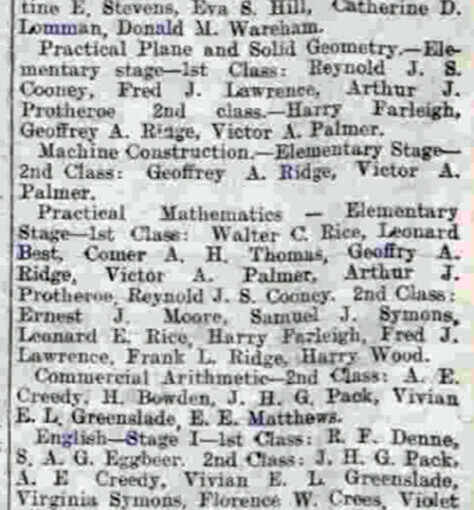
 On 15 May 1865, Churchward—then in the employ of Mr. Eggbeer—was fined 16s. 6d. including costs for “furious driving” in Courtenay Street, Newton Abbot.
-
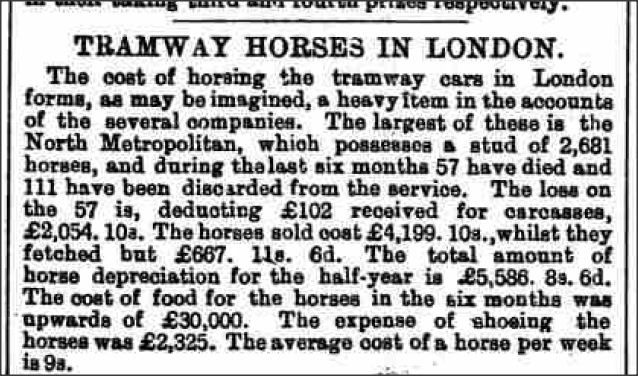
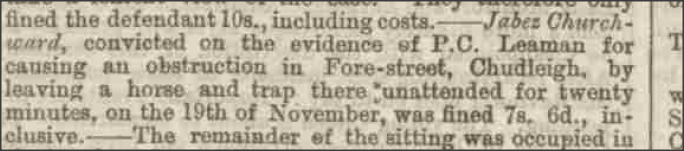 On 19 November 1880 he was again fined 7s. 6d. for causing an obstruction by leaving a horse and trap unattended in Fore Street, Chudleigh, for twenty minutes. The case was proven on the evidence of P.C. Leaman.
These charges were minor but noted. They reflect a man regularly working with horses and carts—an occupation that required skill, caution, and above all, reliability in a town increasingly sensitive to road safety and public order.
1881: Charged with Larceny by a Servant
In March 1881, Jabez Churchward’s most serious encounter with the law took place. Then employed as a carter by corn merchant William Henry Lee, Churchward was assigned to deliver a load of oats—roughly forty bushels—from Newton Abbot to Ambrook. When some of the oats failed to arrive, an inquiry revealed that a sack had been partially emptied. Witness testimony confirmed Churchward had diverted a bushel to a man he met on Woolborough Street—though he could not name him. The oats were later traced to George Smith, who admitted receiving them from Churchward for a small sum and some beer.

Jabez Churchward was charged with “Larceny by Servant”—a serious charge in Victorian law due to its breach of employer trust. According to the court register, he was convicted and sentenced to four months’ imprisonment.
Death in the Workhouse
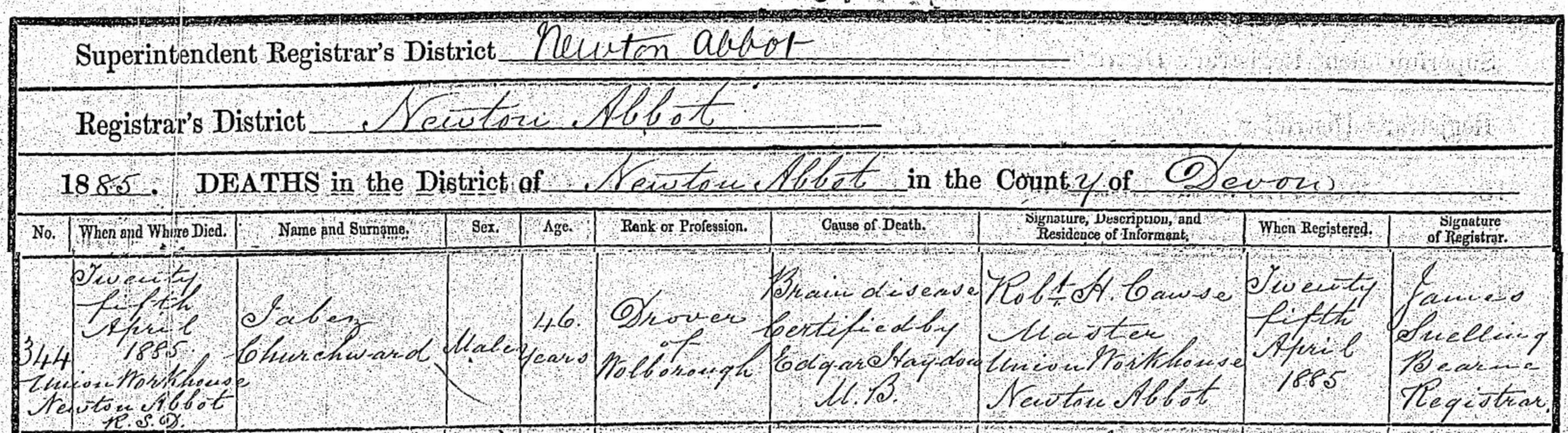 On 25 April 1885, Jabez Churchward died in the Union Workhouse, Newton Abbot, aged 46. His occupation was recorded as “Drover of Wolborough” and the cause of death was “brain disease,” certified by M.B. Edgar Haydon Wilson. His death was registered the same day by Robert H. Causse, workhouse master.
The fact that he died in institutional care suggests he may have suffered a decline in health and circumstances following his release. No surviving records suggest he reoffended after the 1881 conviction.
Summary
Jabez Churchward’s life was not marked by serious criminality, but by repeated minor infringements and one significant lapse in judgment that led to imprisonment. His offences—all non-violent—involved transport, horses, and lapses in responsibility rather than malicious intent.
These records offer a useful and sobering case study in Victorian working-class life: the narrow boundaries of trust, the heavy consequences of even small missteps, and the way working men were monitored and penalised for errors that today might incur little more than a warning.
Jabez was not a notorious figure. But through court ledgers, newspaper reports, and his final record in the workhouse register, we gain a glimpse of how one man lived, worked, and struggled on the margins of a rapidly industrialising society.
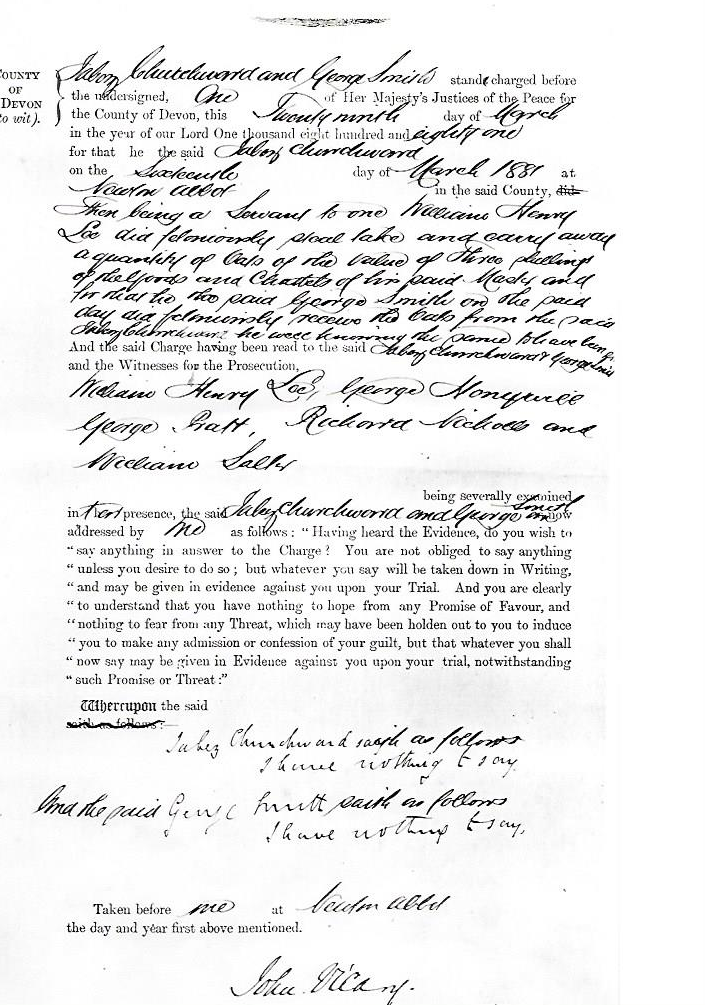
In Court 29th March 1881
COUNTY OF DEVON to wit.
Jabez Churchward and George Smith stand charged before the undersigned, one of Her Majesty’s Justices of the Peace for the County of Devon, this twenty-ninth day of March in the year of our Lord One thousand eight hundred and eighty one for that they the said Jabez Churchward on the sixteenth day of March 1881 at Exeter in the said County, the then being a servant to one William Henry Lee did feloniously steal take and carry away a quantity of tea of the value of three shillings the property of the said Charles Good & Co. and also the said George Smith on the same day and at the same place did receive the said tea, knowing it to have been stolen as aforesaid. And the said Charge having been read to the said John Butterworth & George Smith and the Witnesses for the Prosecution,
William Henry Lee, George Honeywell, George Salt, Richard Nicholls and William Salt being severally examined in their presence, the said Jabez Churchward and George Smith addressed by me as follows: “Having heard the Evidence, do you wish to say anything in answer to the Charge? You are not obliged to say anything unless you desire to do so; but whatever you say will be taken down in Writing, and may be given in evidence against you upon your Trial. And you are clearly to understand that you have nothing to hope from any Promise of Favour, and nothing to fear from any Threat, which may have been holden out to you to induce you to make any admission or confession of your guilt, but that whatever you shall now say may be given in Evidence against you upon your trial, notwithstanding such Promise or Threat.”
Whereupon the said
Jabez Churchward said as follows
I have nothing to say
And the said George Smith said as follows
I have nothing to say
Taken before me at Newton Abbot the day and year first above mentioned.
John Vicary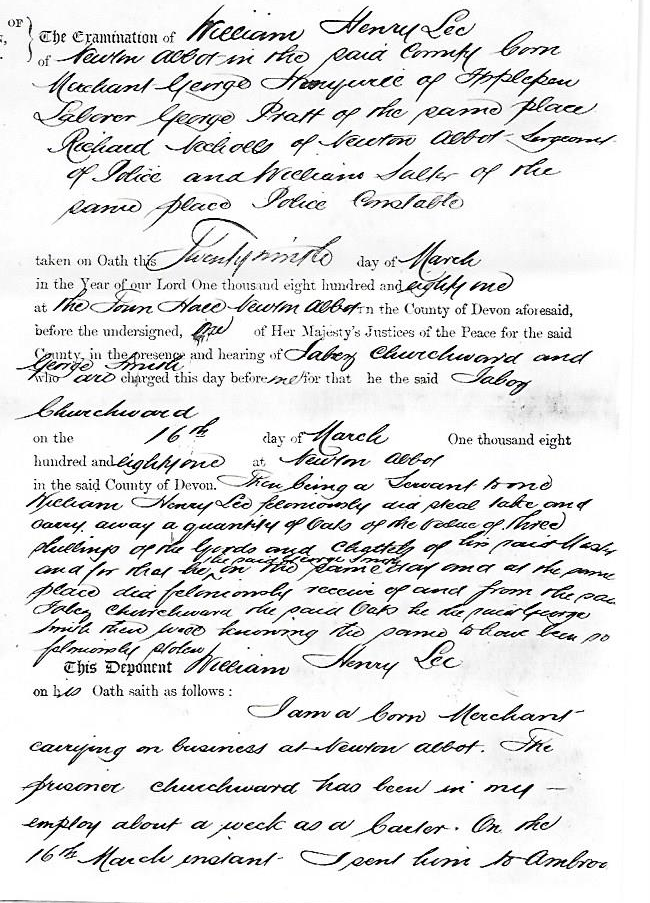
The Examination of William Henry Lee of Newton Abbot in the said County, Corn Merchant, George Honeywell of Applebeare Labourer, George Pratt of the same place, Labourer, Richard Nicholls of Newton Abbot, Inspector of Police and William Salt, of the same place, Police Constable taken on Oath this Twenty ninth day of March in the Year of our Lord One thousand eight hundred and eighty one at the Town Hall, Newton Abbot in the County of Devon aforesaid, before the undersigned, one of Her Majesty’s Justices of the Peace for the said County, in the presence and hearing of Jabez Churchward and George Smith, who stand charged this day before me for that the said Jabez Churchward on the 16th day of March One thousand eight hundred and eighty one at Newton Abbot
in the said County of Devon, then being a servant to one William Henry Lee, feloniously did steal take and carry away a quantity of tea of the value of three shillings the goods and chattels of the said William Lee. And that the said George Smith, on the same day and at the same place, did feloniously receive of and from the said Jabez Churchward a part of the said tea, he the said George Smith then well knowing the same to have been feloniously stolen.
This Deponent William Henry Lee on his Oath saith as follows:—
I am a Corn Merchant carrying on business at Newton Abbot. The prisoner Churchward has been in my employ about a week as a carter. On the 16th March instant I sent him to Ambro—
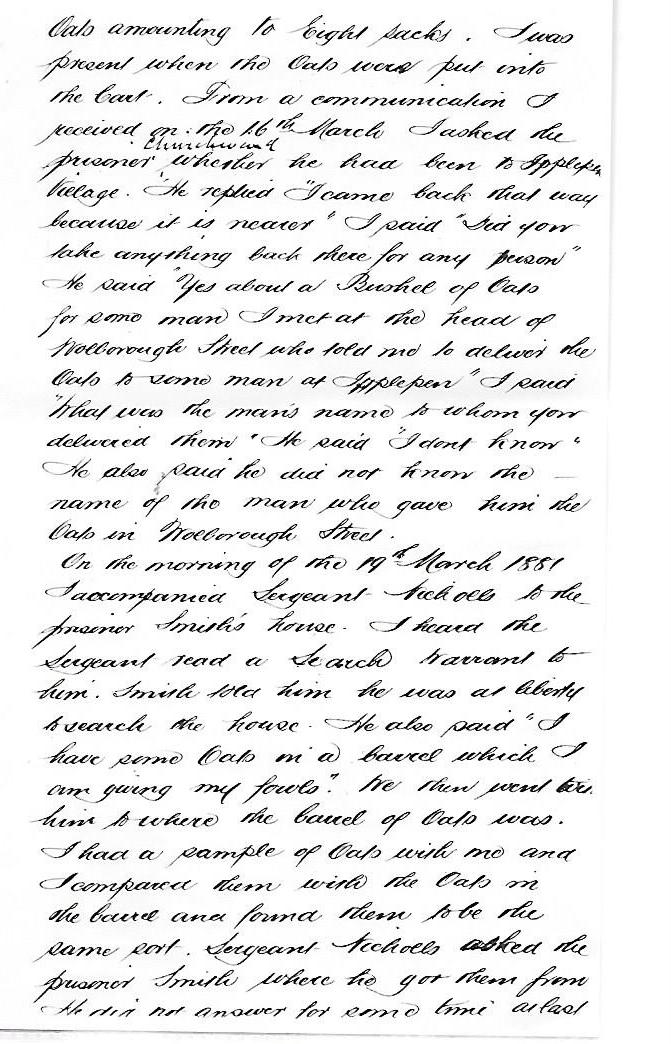 Oats amounting to eight sacks. I was present when the Oats were put into the cart. From a communication I received on the 16th March I asked the prisoner Churchward whether he had been to Appleshaw Village. He replied “I came back that way because it is nearest.” I said “Did you take anything back there for any person?”
He said “Yes, about a Bushel of Oats for some man I met at the head of Woolborough Street who told me to deliver the Oats to some man at Appleshaw.” I said “What was the man’s name to whom you delivered them?” He said “I don’t know.” He also said he did not know the name of the man who gave him the Oats in Woolborough Street.
On the morning of the 17th March 1881 I accompanied Sergeant Nicholls to the prisoner Smith’s house. I heard the Sergeant read a Search Warrant to him. Smith told him he was at liberty to search the house. He also said “I have some Oats in a barrel which I am giving my fowls.” He then went with him to where the barrel of Oats was. I had a sample of Oats with me and I compared them with the Oats in the barrel and found them to be the same sort. Sergeant Nicholls asked the prisoner Smith where he got them from. He did not answer for some time and at last
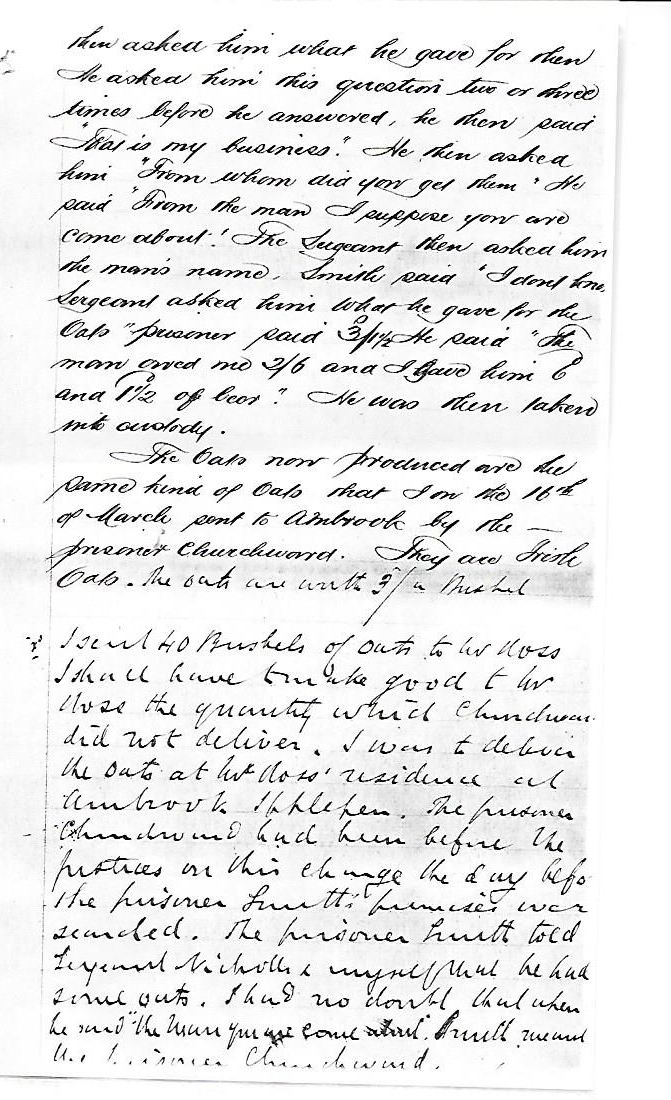 then asked him what he gave for them. He asked him this question two or three times before he answered. He then said
“That is my business.” He then asked him “From whom did you get them?” He said “From the man I suppose you’ve come about.” The Sergeant then asked him the man’s name. Smith said “I don’t know.” Sergeant asked him what he gave for the Oats. Prisoner said “3/4.” He said “the man owed me 2/6 and I gave him 6d and 1½ of beer.” He was then taken into custody.
The Oats now produced are the same kind of Oats that I on the 16th of March sent to Ambrook by the prisoner Churchward. They are White Oats, the bulk is worth 3/– a bushel.
I sent 40 Bushels of Oats to Mr Moss. I shall have trouble to get the good to Mr Moss the quantity which Churchward did not deliver. I was to deliver the Oats at Mr Moss’s residence in Ambrook, Iddesleigh. The prisoner Churchward had been before the Justices on this charge the day before the prisoner Smith’s premises were searched. The prisoner Smith told Sergeant Nicholls & myself that he had some Oats. I have no doubt that when he met the man “you’ve come about” Smith meant the prisoner Churchward.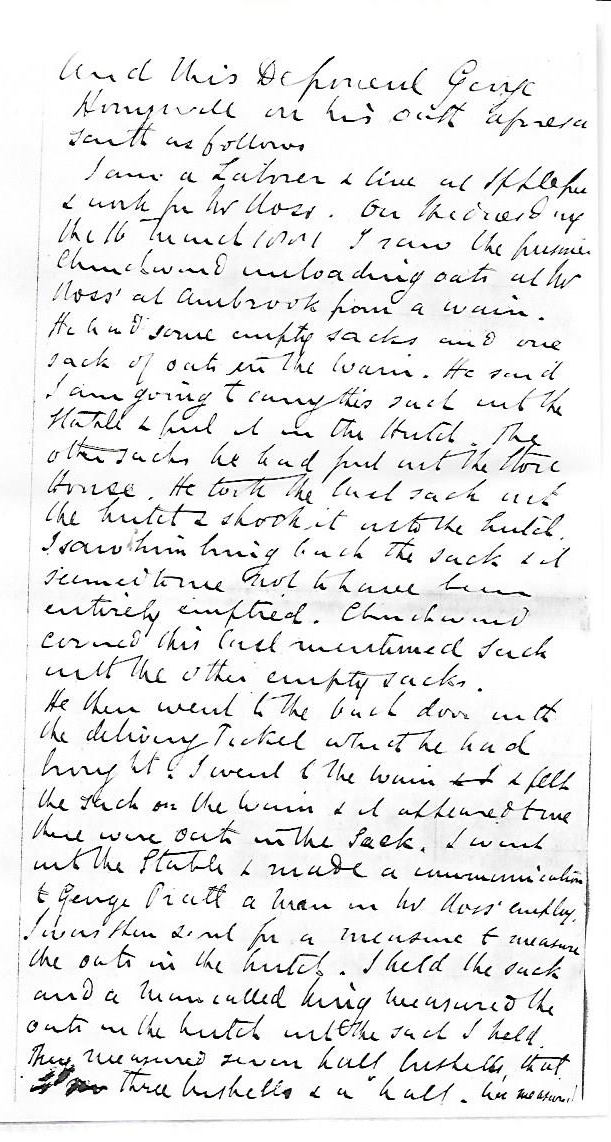
And this Deponent George Honeywell on his oath saith as follows:
I am a labourer & live at Appleshaw & work for Mr Moss.
On Wednesday the 16th March 1881, I saw the prisoner Churchward unloading oats at Mr Moss at Ambrook from a wain. He had some empty sacks and one sack of oats on the wain.
He said “I am going to carry this sack into the Hotel & put it in the Hotel.” The other sacks he had put into the store house. He took the last sack into the Hotel & shook it outside the Hotel. I saw him bring out the sack out several times but he neverentirely emptied it. Churchward covered this last mentioned sack with the other empty sacks. He then went to the back door into the delivery & asked what he had to buy &c. I went to the wain & felt the sack on the wain & I observed there were oats in the sack. I went into the Hotel & made a communication to George Pratt, a man in Mr Moss’ employ. I sent him out for a measure to measure the oats in the Hotel. I held the sack and a man called King measured the oats in the Hotel into the sack I held.
They measured seven full bushels and three bushels & a half in the Hotel.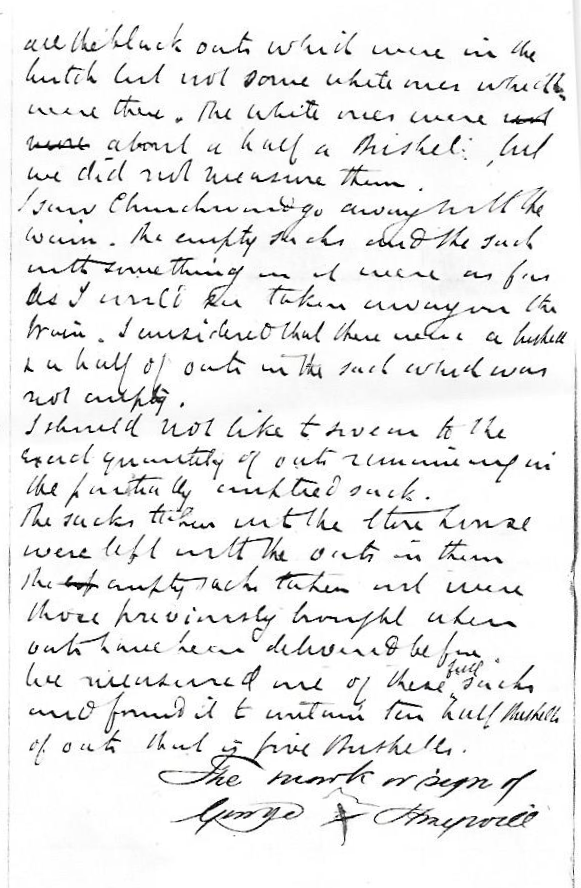
All the black oats which were in the hotel but not some white ones which were there.
The white ones were not more than about a half a bushel: but we did not measure them. Young Churchward go away with the wain.
The empty sacks and the sack with something in I never saw from As I recall, he taken away over the wain. I considered that there rather a bushel & a half of oats in the sack which was not empty. I should not like to swear to the exact quantity of oats remaining in the partially emptied sack.
The sacks taken into the store house were left with the oats in them. The empty sack taken out were those previously brought when oats have been delivered before.
We measured one of these sacks and found it to contain two bushels of oats that is five bushels.
The mark or sign of
George X Honeywell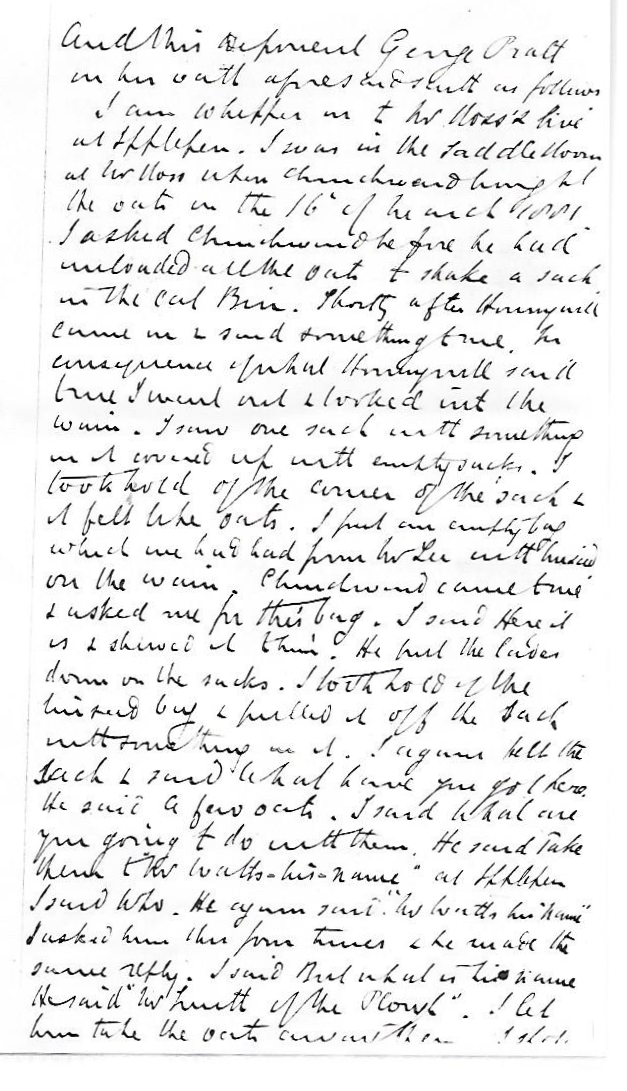
And this Deponent George Pratt on his oath aforesaid saith as follows:
I am a Whitsler in Mr Moss’s hire at Appleshaw. I was in the saddle room at Mr Moss’s when Churchward brought the oats on the 16th of March 1881.
I asked Churchward before he had unloaded all the oats to shake a sack in the coal bin. Shortly after Honeywell came in & said something to me.
The consequence of what Honeywell said was I went out & looked into the wain. I found one sack with something in it covered up with empty sacks. I looked well off the corner of the sack & I felt like oats.
I put an empty bag which we had had from Wotton underneath on the wain. Churchward came out & asked me for this bag. I said there it is & showed it to him. He said he laid it down on the sacks. I took hold of the turned up & pulled it off the sack with something in it. I again felt the sack & said “What have you got here?” He said “a few oats.” I said “What are you going to do with them.” He said “Take them to the Wotton’s—his name is at Haldon.” I said “Who.” He again said “He won’t be known.” I asked him three or four times & he made the same reply. I said “What what is this man’s name.” He said “He won’t be known.” I let him take the oats away with him.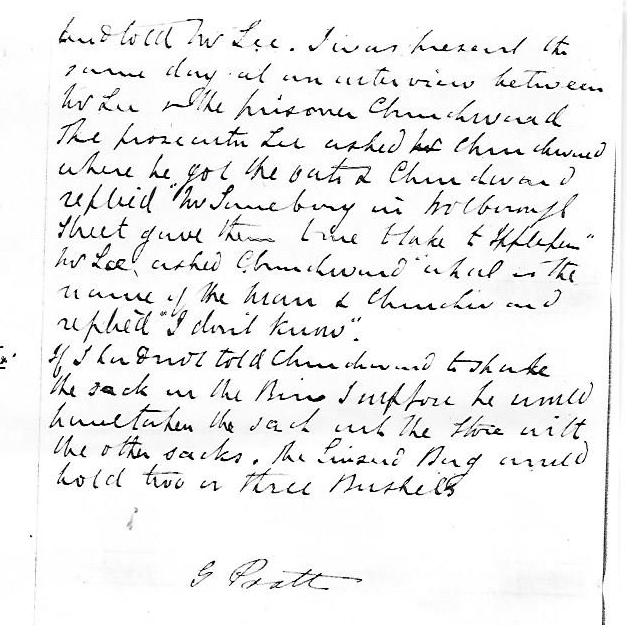
and with Mr Lee. I was present the same day at an interview between Mr Lee and the prisoner Churchward.
The prosecutor Lee asked Churchward where he got the oats. Churchward replied “The same boy in Woolborough Street gave them — like Blake & Haldon.” Mr Lee asked Churchward “what is the name of the man” & Churchward replied “I don’t know.” If I had not told Churchward to shake the sack in the Bin I suppose he would have taken the sack into the store with
the other sacks. The linen bag would hold two or three bushels.
G. Pratt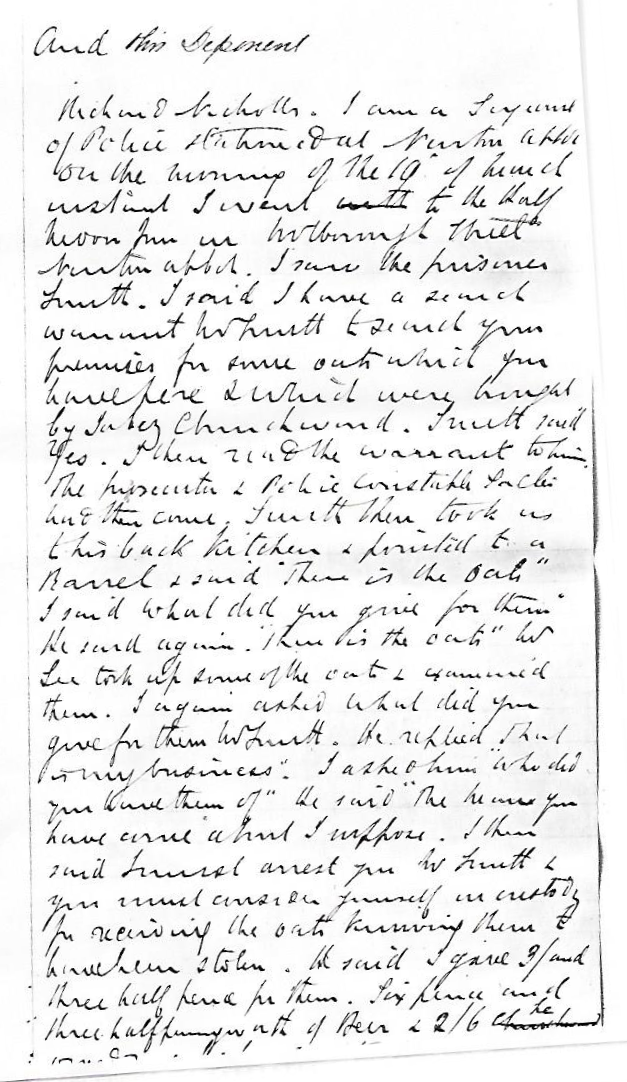
And this Deponent
Richard Nicholls. I am a Sergeant of Police stationed at Newton Abbot. On the morning of the 17th of March instant I went to the half room Inn in Woolborough Street, Newton Abbot.
I saw the prisoner Smith. I said “I have a search warrant Smith to search your premises for some oats which you have here and which were brought by Jabez Churchward.” Smith said “Yes.”
I then read the warrant to him. The prosecutor & Police Constable Salt were then come. Smith then took us to the back kitchen & pointed to a barrel & said “There is the oats.”
I said “What did you give for them?” He said again “Them is the oats.” He then took off some of the oats & examined them. I again asked “What did you give for them Smith?” He replied “That’s my business.” I asked him “Who did you have them of?” He said “The man you have come about I suppose.”
I then said “I must arrest you Mr Smith & you must consider yourself in custody for receiving the oats knowing them to have been stolen.” He said “I gave 9 and three half pence for them. The man owed three halfpennyworth of Beer & 2/6 (Churchward)…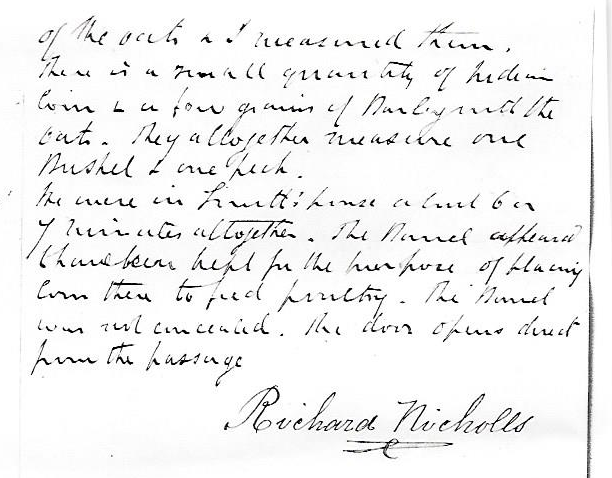
of the oats & measured them.
There is a small quantity of Indian corn & a few grains of Barley with the oats. They altogether measured one bushel & one peck. We were in Smith’s house about 6 or 7 minutes altogether. The barrel appeared to have been kept for the purpose of taking corn there to feed poultry. The barrel was not concealed. The door opens direct
rom the passage.
Richard Nicholls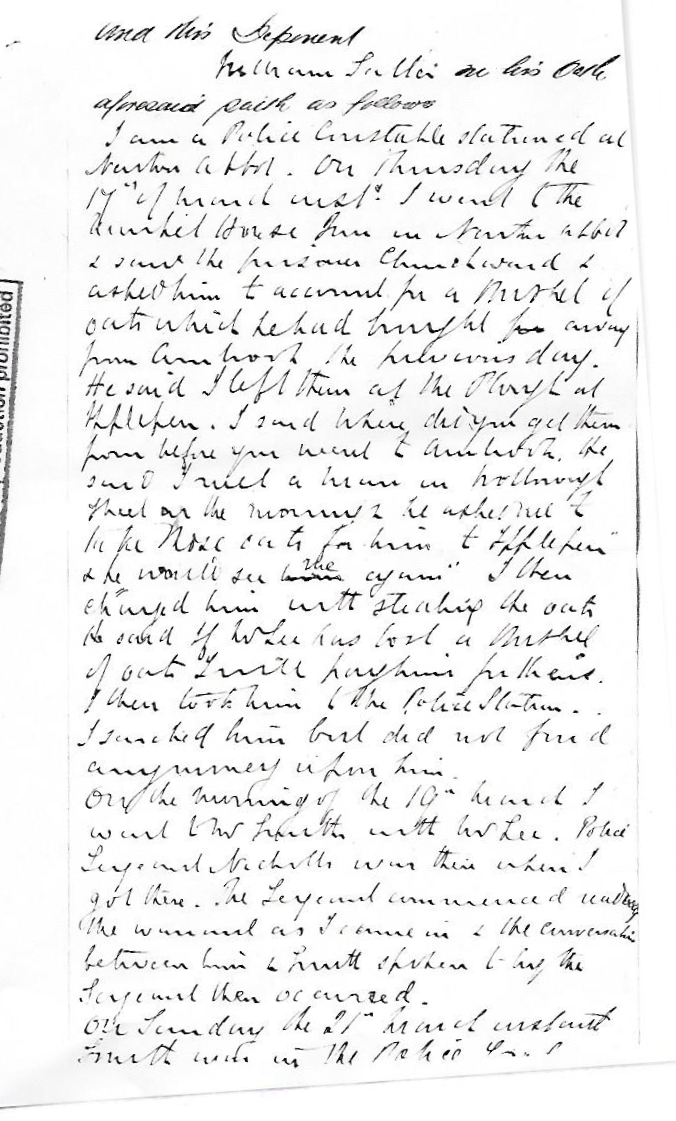
William Salt on his oath
aforesaid saith as follows:
I am a Police Constable stationed at Newton Abbot. On Thursday the 17th of March inst. I went to the Market House Inn in Newton Abbot.
I saw the prisoner Churchward & asked him to account for a Bushel of oats which he had brought to carry from Ambrook the previous day. He said “I left them at the Powder at Haldon.” I said “Where did you get them from before you went to Ambrook.”
He said “I met a man in Woolborough Street on the morning & he asked me to take those oats for him to Haldon & he would see me there again.” I then charged him with stealing the oats. He said “Mr Lee has got a bushel of oats I will purchase perhaps.” I then took him to the Police Station. I searched him but did not find any money upon him.
On the morning of the 19th March I went into Smith’s with Mr Lee. Police
Sergeant Nicholls was there when I got there. The Sergeant commenced reading the warrant as I came in. The conversation between him & Smith spoken to by the Sergeant then occurred.
On Thursday the 17th March instant Smith was in the Police Yard.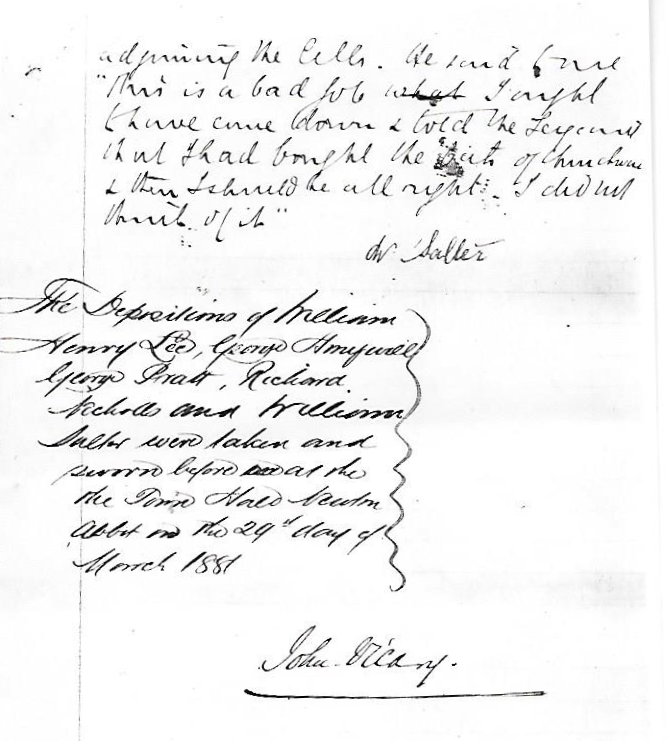
admiring the cells, he said (an this is a bad job what I ought to have come down & told the Sergeant that I had brought the oats of Churchward & then I should be all right. I did not think of it.”)
W. Salt
The Depositions of William Henry Lee, George Honeywell, George Pratt, Richard Nicholls and William Salt were taken and sworn before me at the the Town Hall Newton Abbot on the 29th day of March 1881
John Vicary