The Café Royal murder of December 1894 is one of those rare Victorian cases that sits between documented fact and enduring mystery. A man was killed inside one of London’s most prestigious establishments, yet despite immediate investigation and widespread press coverage, no one was ever convicted. For over a century, the case lingered in the historical record as a fragment — incomplete, misreported, and largely misunderstood.
At its centre was a man long known only as “Marius Martin”, a French employee whose identity remained uncertain. Recent research has now corrected that record. The victim was Edmond Maria Martin, born in the Yonne region of France, a husband and father whose life can be traced beyond the walls of the Café Royal. This discovery transforms the case from an anonymous crime into a real human tragedy, grounded in identifiable people and places.

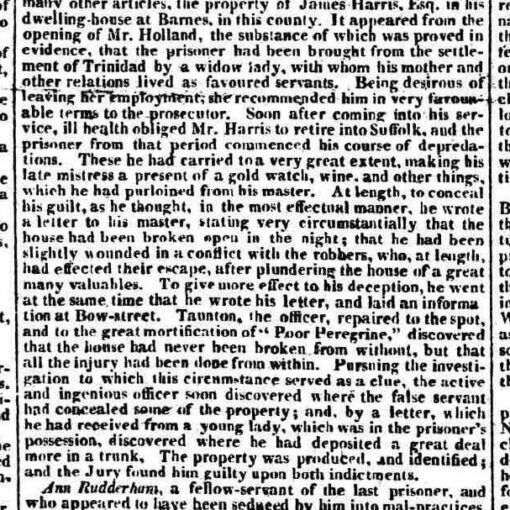
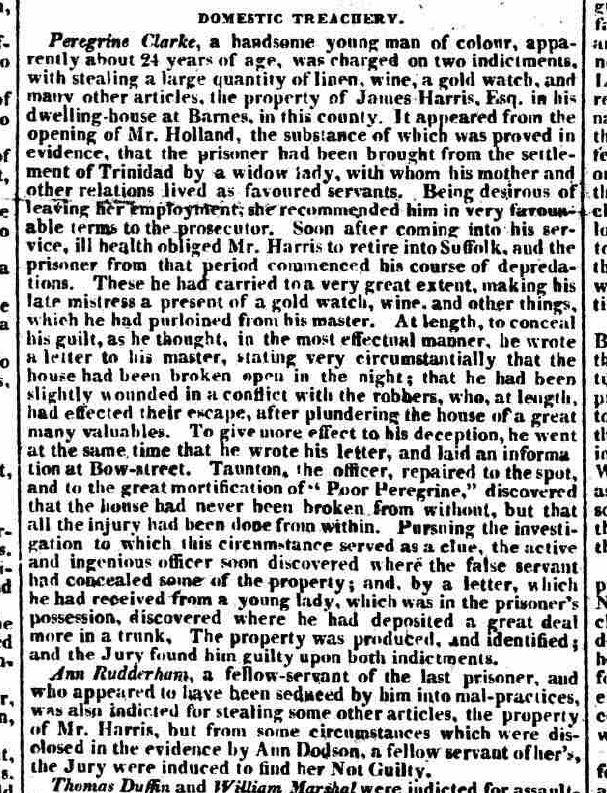
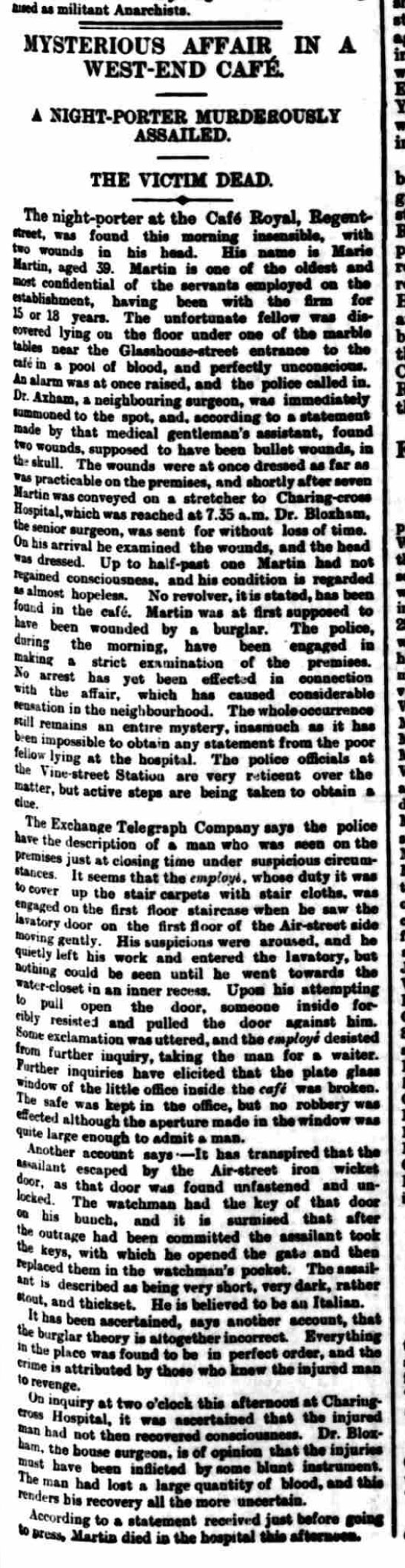
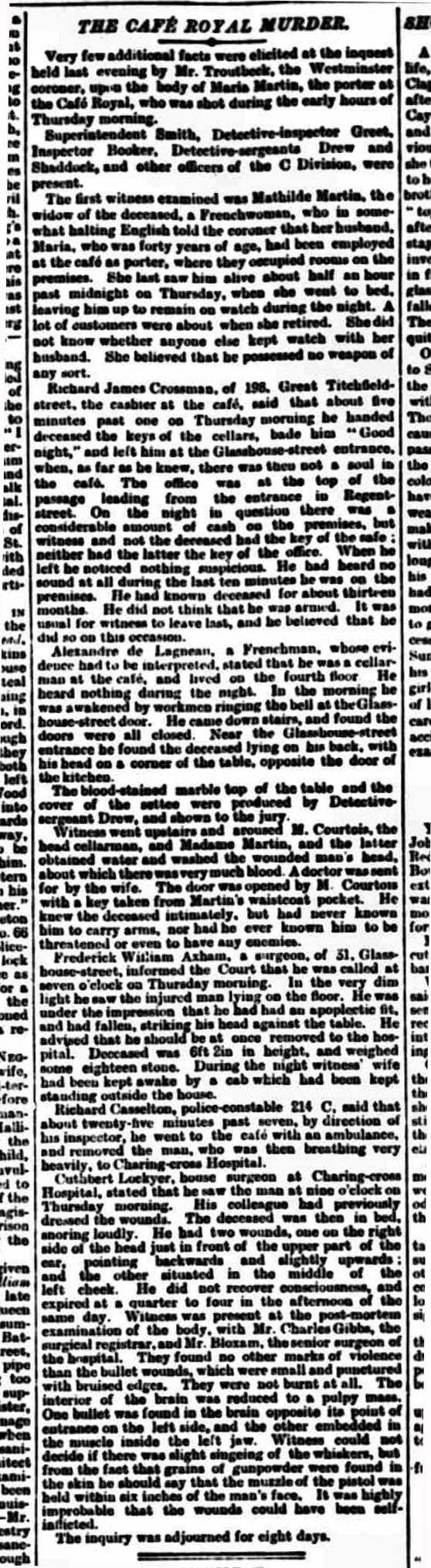
The surviving newspaper reports — from the Pall Mall Gazette, the Evening Standard, and others — provide a detailed but fragmented account of the murder. They describe a scene initially assumed to be a burglary, yet one that quickly revealed inconsistencies: little was taken, the keys were handled with care, and the circumstances suggested knowledge rather than chance. When read together, these contemporary accounts point toward a far more deliberate act.
Today, the Café Royal murder can be understood with far greater clarity than ever before. While the identity of the killer remains unknown, the evidence strongly suggests a targeted killing within a controlled environment, likely involving someone familiar with both the premises and the victim himself. It is no longer simply an unsolved crime — it is a case that can now be properly examined, reconstructed, and, to some degree, understood.
The Man Behind the Name — And the Crime That Never Closed
In the early hours of December 1894, within one of London’s most prestigious establishments, a man was killed in circumstances that have never been satisfactorily explained.
The case was reported at the time with urgency and intrigue. Newspapers spoke of burglary, of mystery, of foreign intrigue, of a crime committed in the very heart of the West End. Yet, like so many cases of the period, it faded. No arrest followed. No trial. No resolution.
For over a century, the victim remained little more than a name — and even that name was uncertain.
Today, however, that position has changed.
This is no longer simply the story of “Marius Martin,” a shadowy French servant found dead at the Café Royal.
It is the story of Edmond Maria Martin — a real man, with a home, a family, and a life that can now be traced back to rural France.
And it is the story of a murder that, even now, can be reconstructed with far greater clarity than ever before.
The Discovery
The Café Royal, situated on Regent Street, was one of London’s most fashionable establishments — a place of refinement, wealth, and continental influence. It was staffed largely by French employees, and operated with a disciplined internal structure.
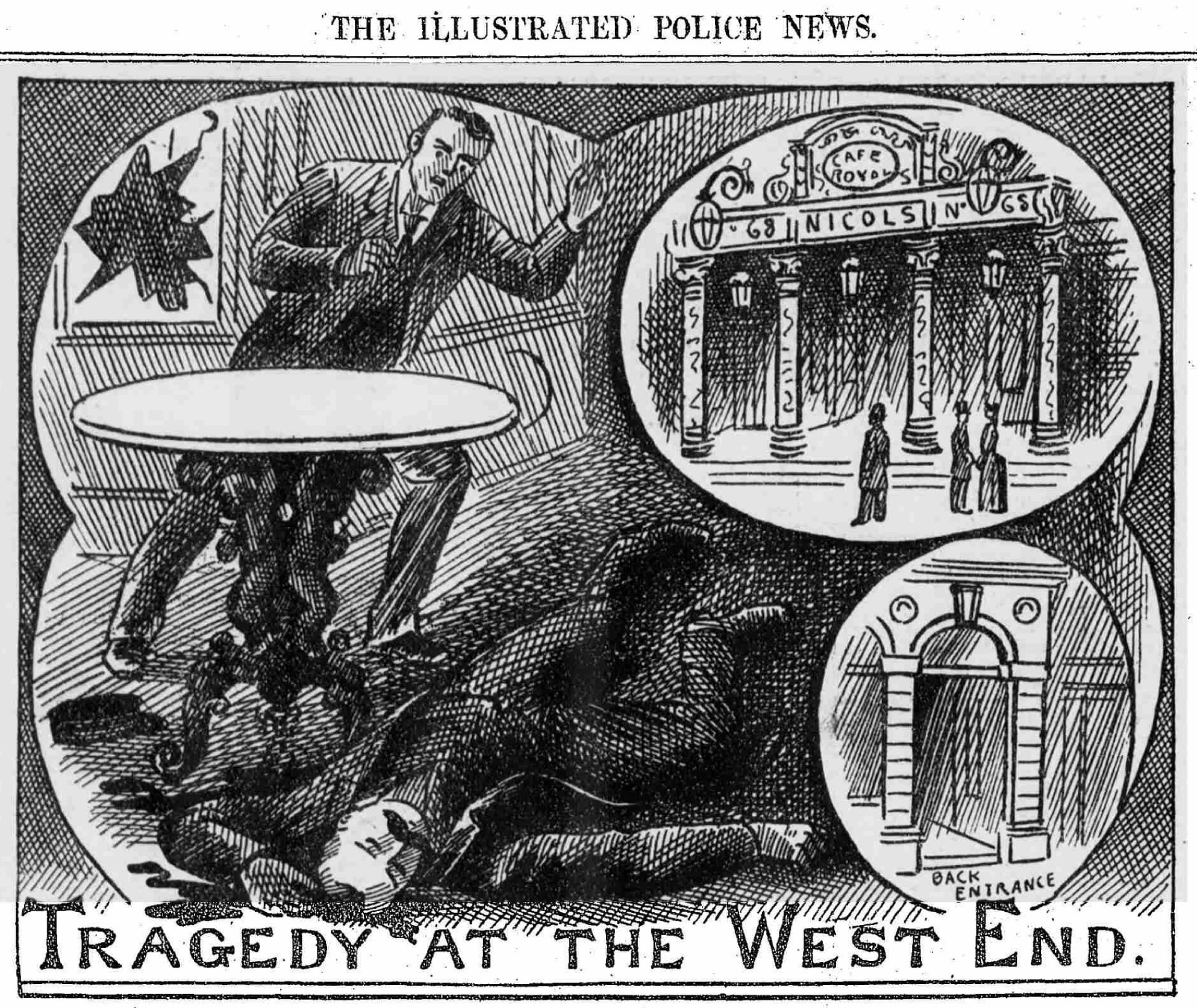
On the morning in question, Martin — a trusted employee responsible for securing the premises — was found dead inside the building.
Contemporary newspaper reports, including those in the Pall Mall Gazette, describe the scene in stark terms. Martin lay within the premises, fatally wounded. Initial confusion gave way to the recognition that this was no accident, but a deliberate act of violence.
The immediate assumption was burglary.
Yet from the very beginning, there were problems with that explanation.
The Problem with Burglary
The newspapers of the day repeatedly returned to the same question:
If this was a burglary — why was so little taken?
The safe was not successfully opened. There was disturbance, certainly — broken glass, signs of attempted entry — but nothing consistent with a successful theft of value.
More troubling still were the keys.
Martin was known to carry a set of keys essential to the operation of the building. These keys were found, but not as expected. Evidence suggests they had been removed and returned — handled, used, and then replaced.
This is not the behaviour of a panicked intruder.
It is the behaviour of someone who remained calm after the killing.
A Man Who Was Not What He Seemed
For decades, the victim was known only as “Marius Martin” or “Maria Martin,” a French employee in London.
Recent research changes that entirely.
The man was Edmond Maria Martin, born in 1854 at Vachy, in the commune of Champlost, in the Yonne region of France.
He married Mathilde Anastasie Mittet in 1881. They had children. He belonged to a real family, in a real place, with a documented life.
The use of “Marius” in English newspapers appears now to have been a simple Anglicisation — or misrendering — of “Maria,” a name not uncommon in French usage.
This discovery is not merely genealogical.
It changes the nature of the case.
The Café Royal World
The Café Royal was not an anonymous workplace. It was a structured environment, with hierarchy, discipline, and a strong French presence.
Martin was not a casual labourer. He was a trusted figure within that structure — a man responsible for security, for keys, and for maintaining order.
Newspaper reports suggest he was strict in his duties. It was even stated that his actions had led to the dismissal of other employees.
If true, that is highly significant.
Because it introduces motive.
The Night Reconsidered
Reconstructing the events from the available evidence leads to a striking conclusion.
It is highly unlikely that the killer simply broke in from the street.
Instead, the evidence points toward a different scenario — one hinted at even in contemporary reports:
A man seen lingering inside the premises.
A light left burning.
A sense that someone remained where they should not have been.
The most coherent reconstruction is this:
The killer was already inside.
He waited.
He knew that Martin would be alone.
When the moment came, the encounter was brief and decisive. Martin, a physically strong man, was not engaged in a prolonged struggle. He was overcome quickly — most likely by sudden, close-range violence.

Afterwards, the killer did not flee blindly. He had time — enough to handle the keys, to move within the building, and to leave without immediate detection.
Who Was the Killer?
No name was ever proven.
But the range of possibility is now far narrower than it once appeared.
The killer was almost certainly:
- Someone familiar with the Café Royal
- Someone who understood its layout
- Someone who could move within it without immediate suspicion
Most plausibly:
- A current employee
- A former employee
- Or someone within the same French service network that surrounded the establishment
The idea of a random outsider becomes increasingly difficult to sustain.
The End of the Case — and Why It Failed
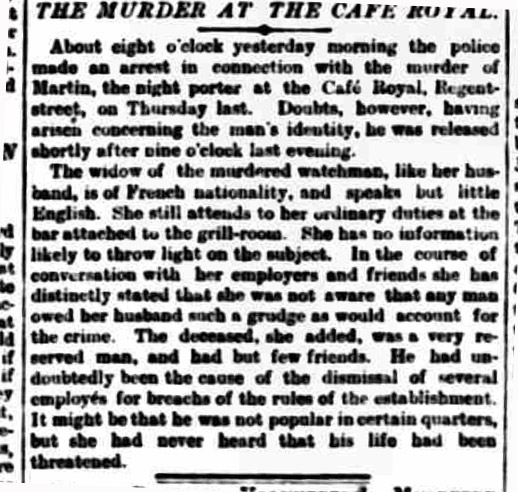
The investigation, as reported in the press, was extensive but inconclusive.
Police explored the foreign communities of Soho. Suspects were considered. Lines of enquiry opened — and closed.
But the case drifted.
Why?
The answer likely lies not in one failure, but in several:
- Language barriers
- Tight-knit staff loyalties
- Limited forensic capability
- The transient nature of service workers
- And perhaps, above all, the difficulty of penetrating an internal social world that did not readily reveal its secrets
The result was inevitable.
The case was never solved.
What We Can Now Say — With Confidence
For the first time, it is possible to state clearly:
- The victim was Edmond Maria Martin, a French national with a known origin and family
- The crime took place within a controlled environment
- The evidence strongly favours a targeted killing, not a random burglary
- The killer likely had knowledge of the premises and of Martin himself
And What Remains Unanswered
We still do not know:
- Why Martin came to London
- Whether he was about to leave
- What conflicts may have followed him from France — or developed in England
- Who, precisely, waited for him that night
An Ending — Of a Different Kind
There is no neat conclusion to this story.
No arrest.
No confession.
No courtroom reckoning.
But there is, now, something else.
There is a man who has been restored to his proper identity.
There is a life that has been reconnected to its origins.
And there is a crime that, though unsolved, can now be understood — not as a vague mystery, but as a real event, in a real place, involving real people whose world we can begin to see again.
Final Reflection
In the end, the Café Royal murder does not offer us closure.
What it offers instead is something more valuable to the historian:
Not certainty — but clarity.
And sometimes, after more than a century, that is as close as we are ever likely to come.
The Role of Newspapers and Editorials in Unraveling the Café Royal Murder
When the Café Royal murder occurred in December 1894, it was the newspapers of the day that first brought the tragic event to public attention. Their immediate reporting and subsequent editorials played a crucial role in documenting the details, speculations, and evolving theories about the case. While the crime itself remained unsolved, these contemporary reports and editorials have been invaluable in reconstructing the story, offering insights, and bringing to light the human element behind the headlines.
Immediate Impact of Newspaper Reporting
The initial reports in papers like the Pall Mall Gazette and others were pivotal in shaping public perception of the crime. They provided the first detailed accounts of the murder, including descriptions of the scene, testimonies from those who discovered the body, and the immediate reactions of law enforcement. These reports laid the groundwork for all subsequent investigations and discussions.
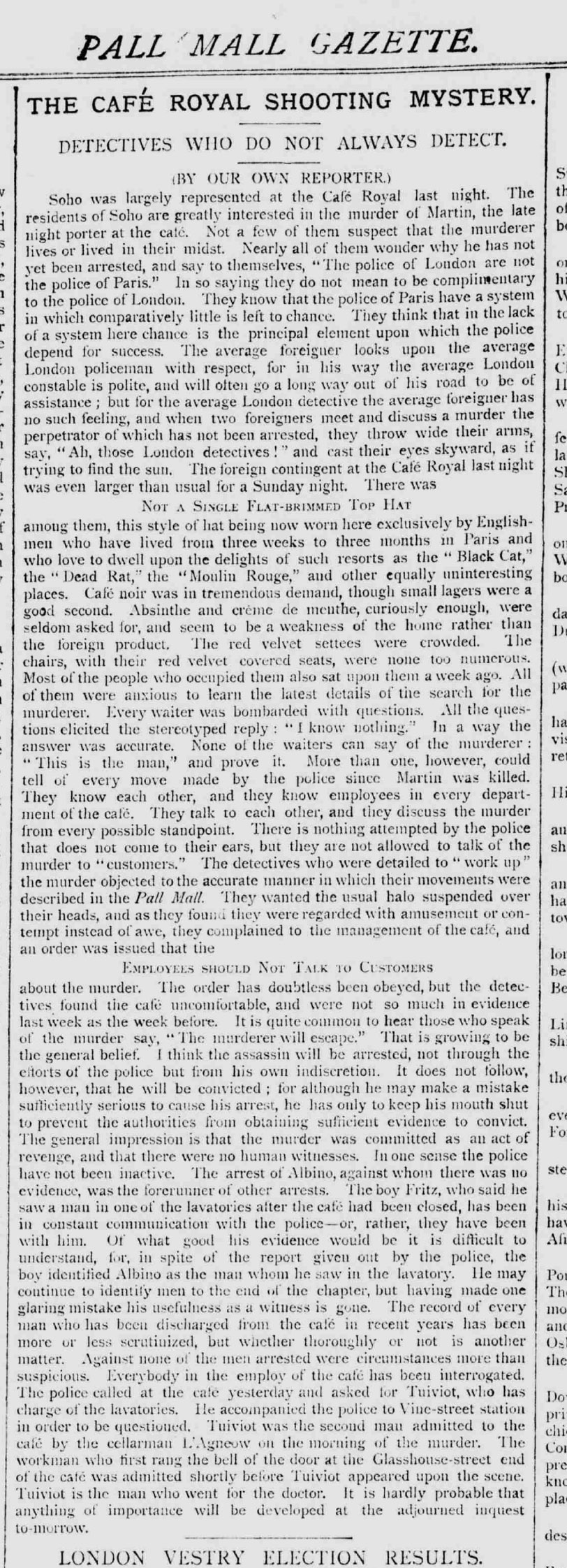
These early articles were instrumental in capturing the public’s imagination and concern. They framed the event not just as a crime, but as a mysterious and dramatic incident that raised questions about safety, justice, and the complexities of urban life in late Victorian London.
The Evolution of Editorial Perspectives
As the days and weeks passed without a resolution, editorials began to play a more significant role. Editors and columnists used their platforms to question the effectiveness of the police, explore alternative theories, and reflect on the broader implications of the crime. These editorials often synthesized the available evidence, highlighted inconsistencies, and maintained public interest in the case long after the initial shock had faded.
Editorials also served as a form of social commentary. They provided a space to discuss broader issues such as the reliability of witness testimonies, the challenges of policing in a rapidly growing city, and the vulnerability of those who worked in service roles. This kept the case in public consciousness and underscored its significance beyond a single act of violence.
Contemporary Reports as Historical Records
The detailed accounts published at the time are now invaluable historical records. They offer a window into the investigative methods, societal attitudes, and journalistic practices of the late 19th century. These reports preserved the narrative of the crime, the personalities involved, and the various leads that were pursued. Without these contemporary reports, much of the detail and context of the Café Royal murder would have been lost to time.
Moreover, these reports have allowed modern researchers and historians to piece together a clearer picture of what happened. They have provided a foundation upon which new discoveries can be made, such as the true identity of the victim and the plausible motives behind the crime.