
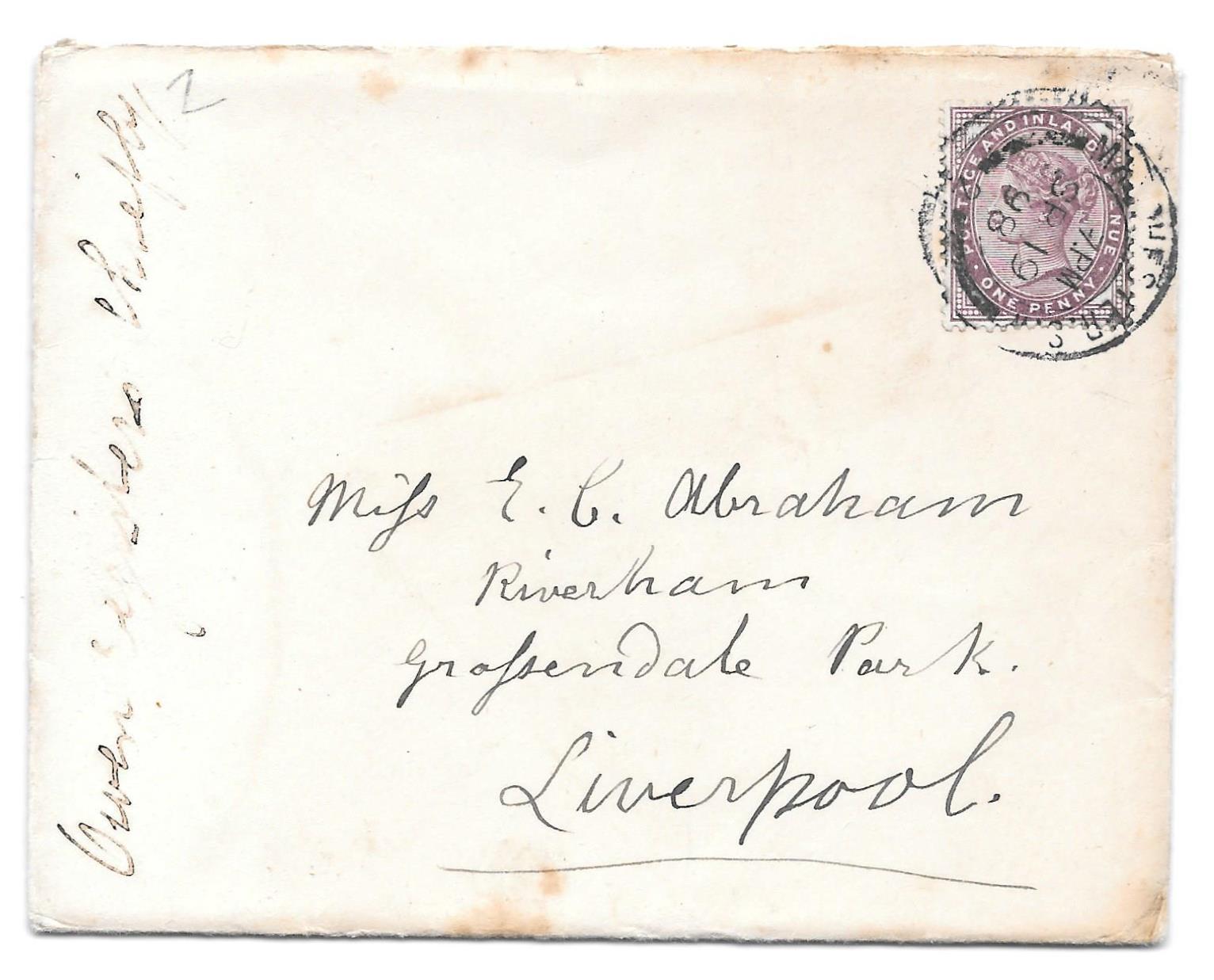
Two letters, written in September and October 1898 by J. Owen to Mrs E. C. Abraham, document a careful search for the marriage of John Abraham and related family links in the Manchester area. Their importance lies not only in the genealogical enquiry itself, but in the evidence they preserve about the records consulted, including missing pages, torn leaves, erased entries, and neglected archival bundles. They therefore stand as valuable research documents in their own right, showing both the methods and the limitations of family history investigation at the end of the nineteenth century.
Taken together, the two 1898 letters are working research reports from J. Owen to Mrs E. C. Abraham about one specific genealogical problem: finding the marriage of John Abraham, and more broadly reconstructing the Abraham family’s mid-17th-century origins in the Manchester–Stockport–Bowdon area.
Overall significance
These are not casual family letters. They are research letters from someone actively searching parish and related records on Mrs Abraham’s behalf. Owen is reporting where he has looked, what he has and has not found, and why the search is proving difficult.
The letters are valuable for three reasons:
First, they show the exact lines of enquiry being pursued in 1898.
Second, they preserve evidence about the state of the records themselves — missing leaves, torn pages, erased entries, and registers that had disappeared and later resurfaced.
Third, they show Owen’s developing theory: that John Abraham’s marriage may not be in the obvious outlying parish registers, but instead may have taken place in Manchester, where record loss has created a gap exactly in the relevant period.
Letter 1: 19 September 1898
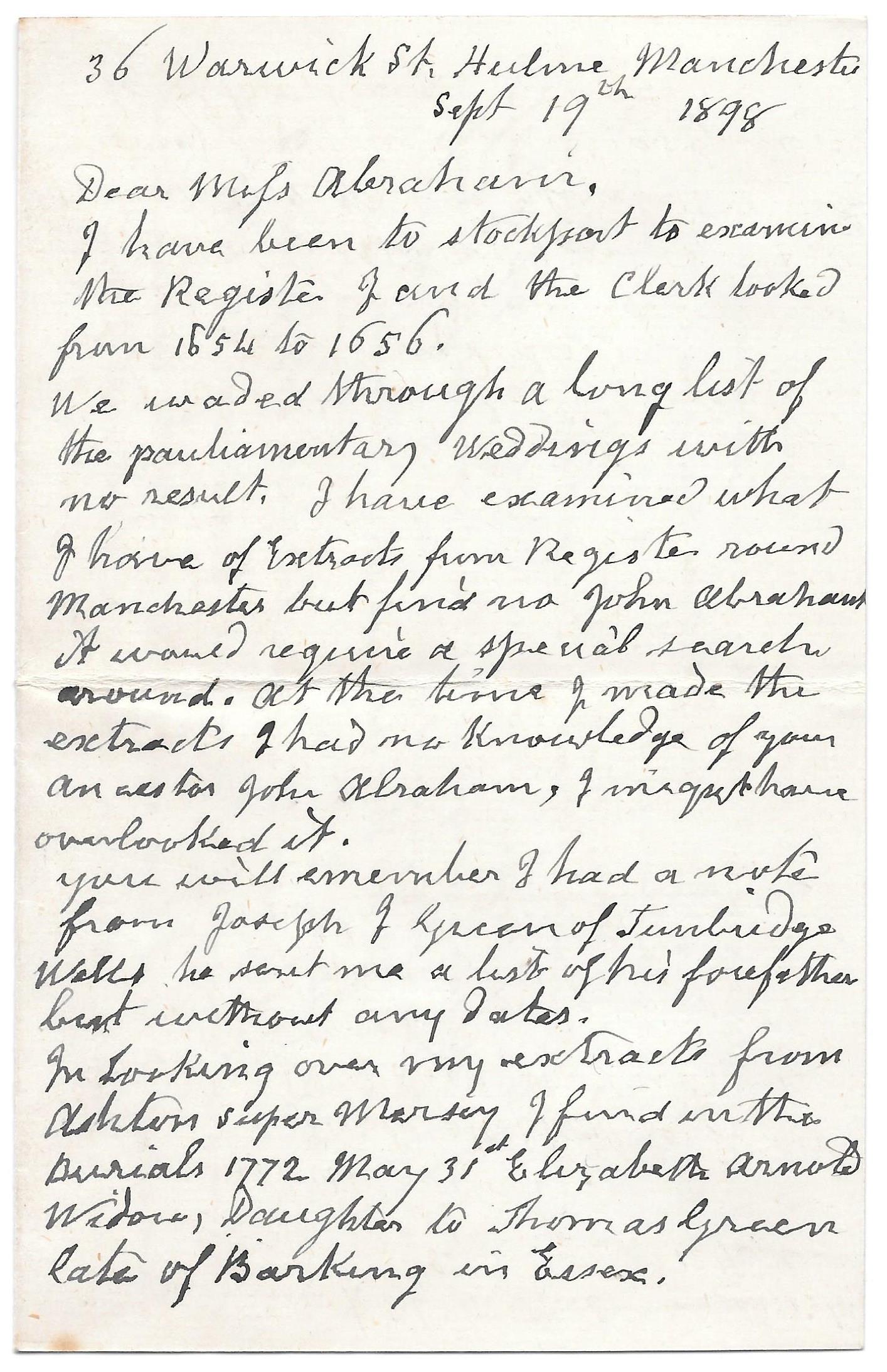
 This first letter is exploratory and wide-ranging. Owen is still testing possibilities.
1. Stockport search
He says he went to Stockport and examined the register, with the clerk looking from 1654 to 1656.
That date range is important. It suggests he believed John Abraham’s marriage likely fell somewhere close to those years. He and the clerk went through a “long list of the parliamentary weddings” but found nothing.
This indicates they were not just checking ordinary parish marriages. They were also considering marriages performed under the Commonwealth / Parliamentary system, which makes sense for the 1650s.
Meaning
Owen is showing that he has already searched one of the most likely record groups for the target period and found no John Abraham.
2. Manchester extracts already held by Owen
 He says he examined his own extracts from Manchester register records, but found no John Abraham. However, he adds a qualification: when he originally made those extracts, he did not yet know about Mrs Abraham’s ancestor John Abraham, so he might have overlooked something.
Meaning
This is an honest and important admission. It tells us:
- Owen had previously copied or abstracted Manchester entries for some other purpose.
- Those notes were not created with the Abraham problem specifically in mind.
- Therefore, his earlier notes are useful but not conclusive.
This is the first sign that Manchester may still be central to the problem.
3. Joseph J. Green of Tunbridge Wells
Owen reminds Mrs Abraham of a note from Joseph J. Green, who had sent him a list of his forefathers without dates.
That tells us there is probably some attempt to connect the Abraham line with a Green line, or at least to test whether Mrs Abraham’s ancestry intersects with that family.
Owen then says that in looking over extracts from Ashton upon Mersey, he found a burial:
1772 May 31 – Elizabeth Annan, widow, daughter to Thomas Green late of Barking in Essex.
Meaning
This is a side-line discovery, but Owen clearly thought it might matter. He is trying to identify whether the Green family in Essex might connect to the same wider family network Mrs Abraham is investigating.
It does not appear to solve the Abraham problem directly, but it shows how genealogical reconstruction was being built by linking scattered parish notices.
4. Manchester register notes: Owen / Owyne / Owen marriages and baptisms
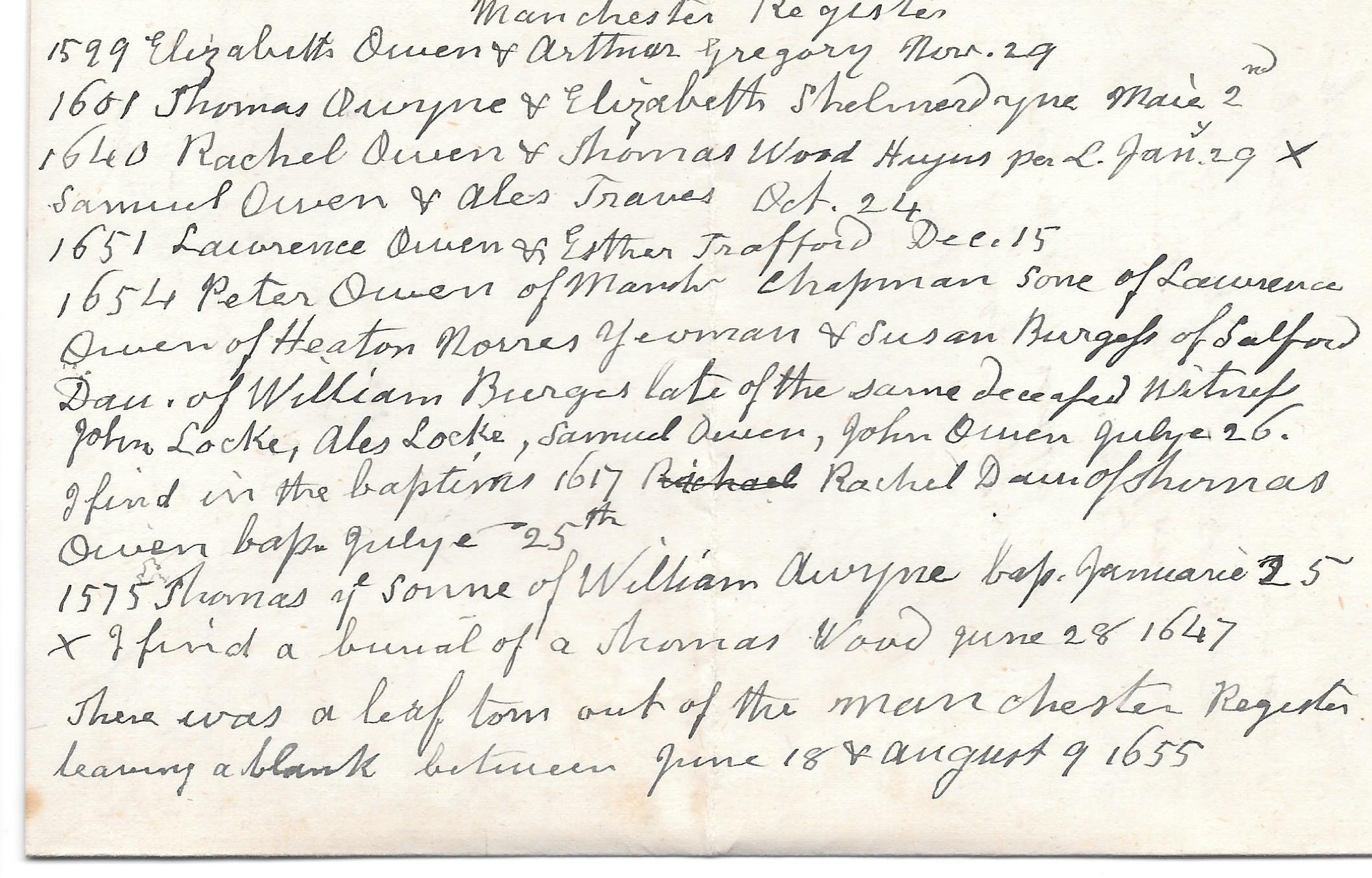 He then copies out a number of Manchester register entries involving Owen / Owyne. These include:
- 1599 Elizabeth Owen & Arthur Gregory
- 1661 Thomas Owyne & Elizabeth Shelmerdyne
- 1640 Rachel Owen & Thomas Wood
- Samuel Owen & Ales Travers
- 1651 Lawrence Owen & Esther Trafford
- 1654 Peter Owen & Susan Burgess
- 1617 Rachel daughter of Thomas Owen baptised
- 1575 Thomas son of William Owyne baptised
He also notes a burial of Thomas Wood in 1647.
Meaning
This part is especially important. Owen is building, or perhaps testing, an Owen family reconstruction, probably because he believes the Owen line intersects with the Abraham problem through marriage or kinship.
The most notable entry is the 1640 marriage of Rachel Owen and Thomas Wood, followed by the burial of Thomas Wood in 1647. That sequence likely matters because in the second letter he refers to Rachel Owen’s first husband dying in 1647. He is clearly tracking Rachel Owen as a woman who may have married again, and whose later marriage may connect into the family Mrs Abraham is researching.
So this is not random copying. He is assembling an evidential chain.
5. Missing leaf in Manchester register
 Owen says:
There was a leaf torn out of the Manchester Register leaving a blank between June 18 & August 9 1655.
This is one of the most significant statements in the first letter.
Meaning
If John Abraham’s marriage fell in that period, the record may once have existed but is now physically lost.
This is not speculation. Owen is describing actual damage to the register.
For your purposes, this means the absence of a marriage entry is not strong negative evidence. It may simply be unrecordable now because the relevant page is gone.
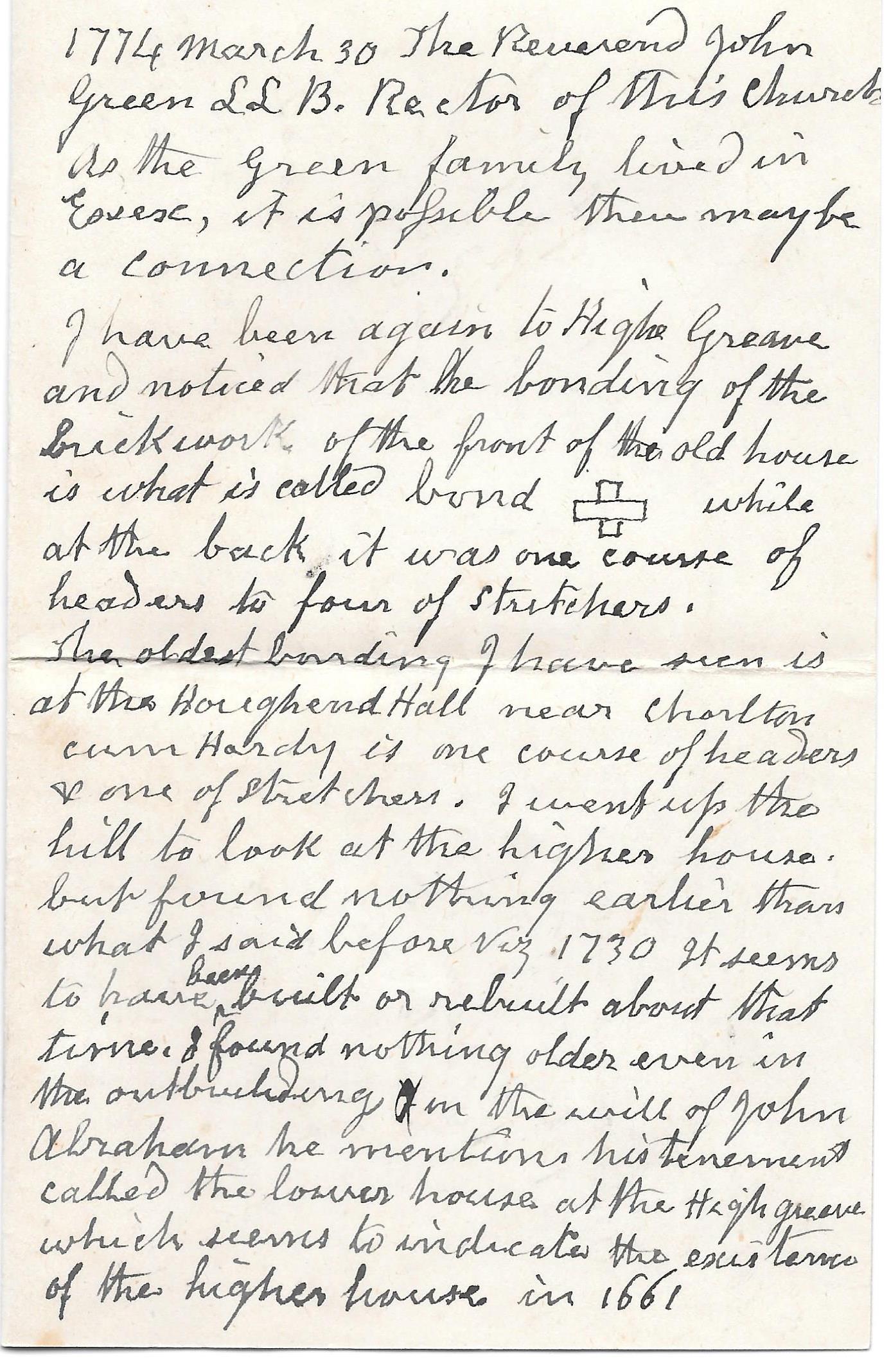
6. High Greave / Higho Greave and the physical landscape
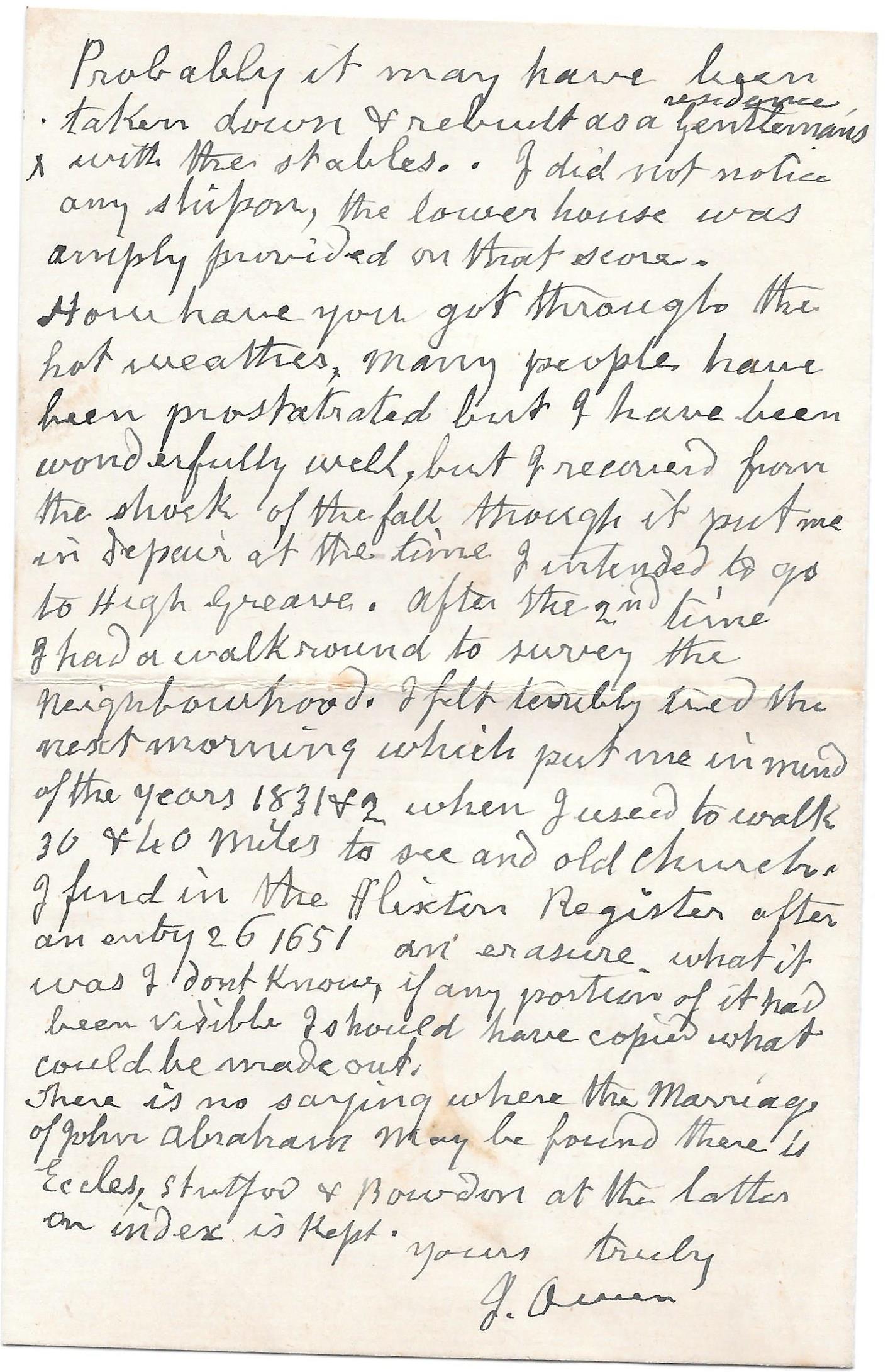 Owen then turns to High Greave. He discusses:
- the brick bonding of the old house
- comparison with another old house near Charlton cum Hardy
- his impression that the higher house showed nothing earlier than about 1730
- a will of John Abraham mentioning “his tenement called the lower house at the High Greave”
- the implication that the “higher house” already existed in 1661
Meaning
This is a different kind of evidence: not parish-register evidence, but topographical and architectural reasoning.
Owen is trying to understand the Abraham property described in the will. He seems to conclude that although the visible building fabric was not earlier than about 1730, the terminology in John Abraham’s will implies that there were already two related properties, a lower house and a higher house, by 1661.
That means the Abraham family’s connection to High Greave may be older than the surviving building fabric suggests.
This is careful historical method for the time: using building evidence and wording in a will together.
7. Personal remarks and physical effort
He mentions:
- recovering from a fall
- walking around the neighbourhood
- feeling terribly tired the next morning
- remembering earlier years when he walked 36 and 40 miles to inspect old churches
Meaning
This gives character to the letter, but it also shows how research was physically done: travel, inspection, direct examination, and note-taking. It also underscores that Owen was making a real effort on Mrs Abraham’s behalf.
8. Hexton Register erasure
He says that in the Hexton Register, after an entry for 26 1651, there is an erasure. He cannot tell what it originally was.
Meaning
This again reinforces the same theme: the record base is incomplete not only because entries are absent, but because some have been deliberately or accidentally erased.
That matters because it weakens any argument based on “if the marriage were there, we would have found it.”
9. Final conclusion of letter 1
He ends by saying:
There is no saying where the Marriage of John Abraham may be found there is Eccles, Stratford & Bowdon at the latter an index is kept.
Meaning
At this stage, he is still keeping several parishes open as possibilities:
- Eccles
- Stretford
- Bowdon
He has not yet settled on Manchester as the likeliest location, though he is beginning to suspect it.
Letter 2: 24 October 1898
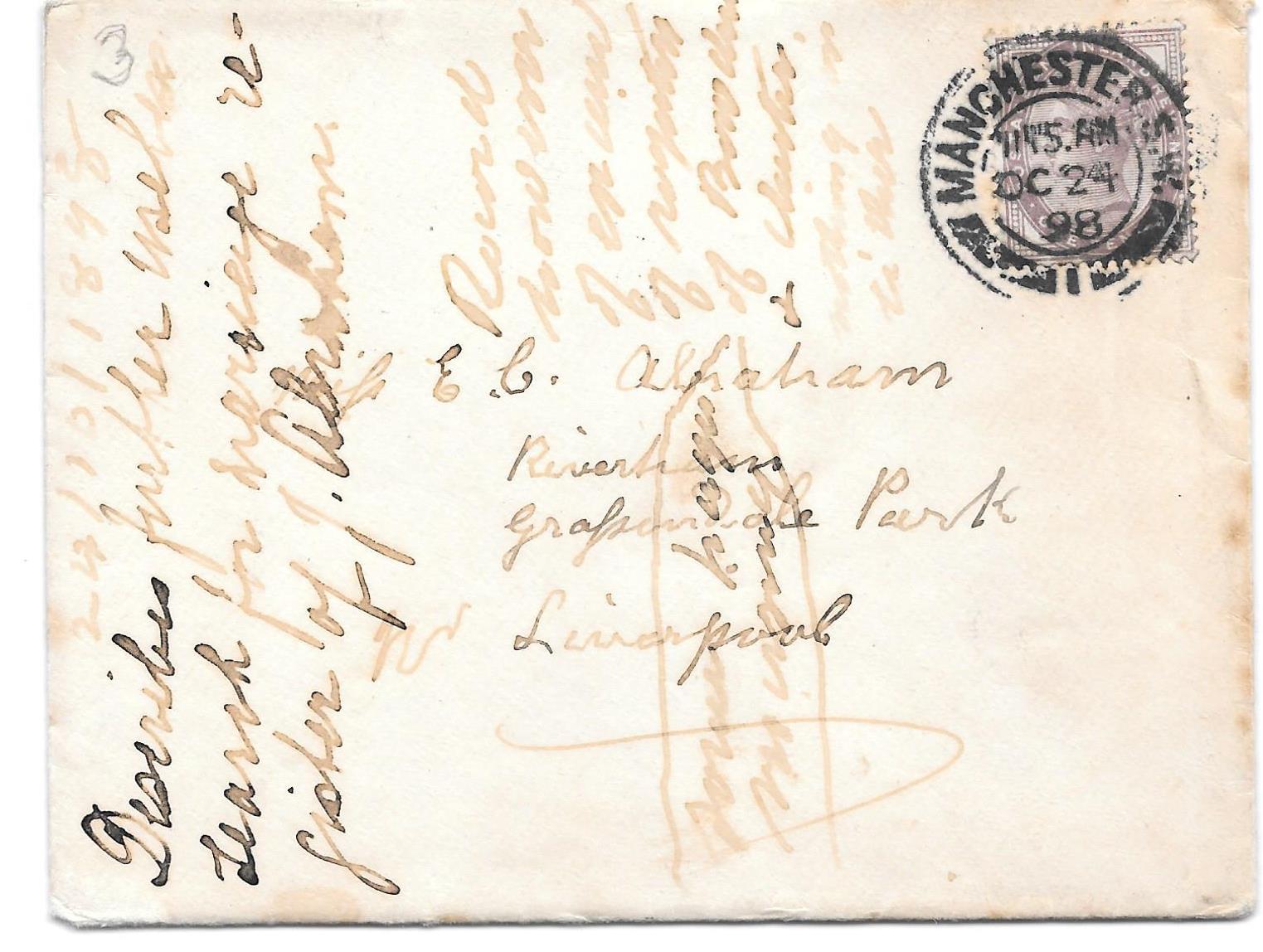 This second letter is more focused and more decisive. It follows on from the earlier enquiries and sharpens the conclusion.
1. Bowdon search completed
Owen says that on Saturday he went to Bowdon and saw the registers, but found no marriage of John Abraham.
Meaning
One of the alternative parishes named in the first letter has now been eliminated, at least on the surviving evidence.
2. Stronger suspicion that the marriage occurred in Manchester
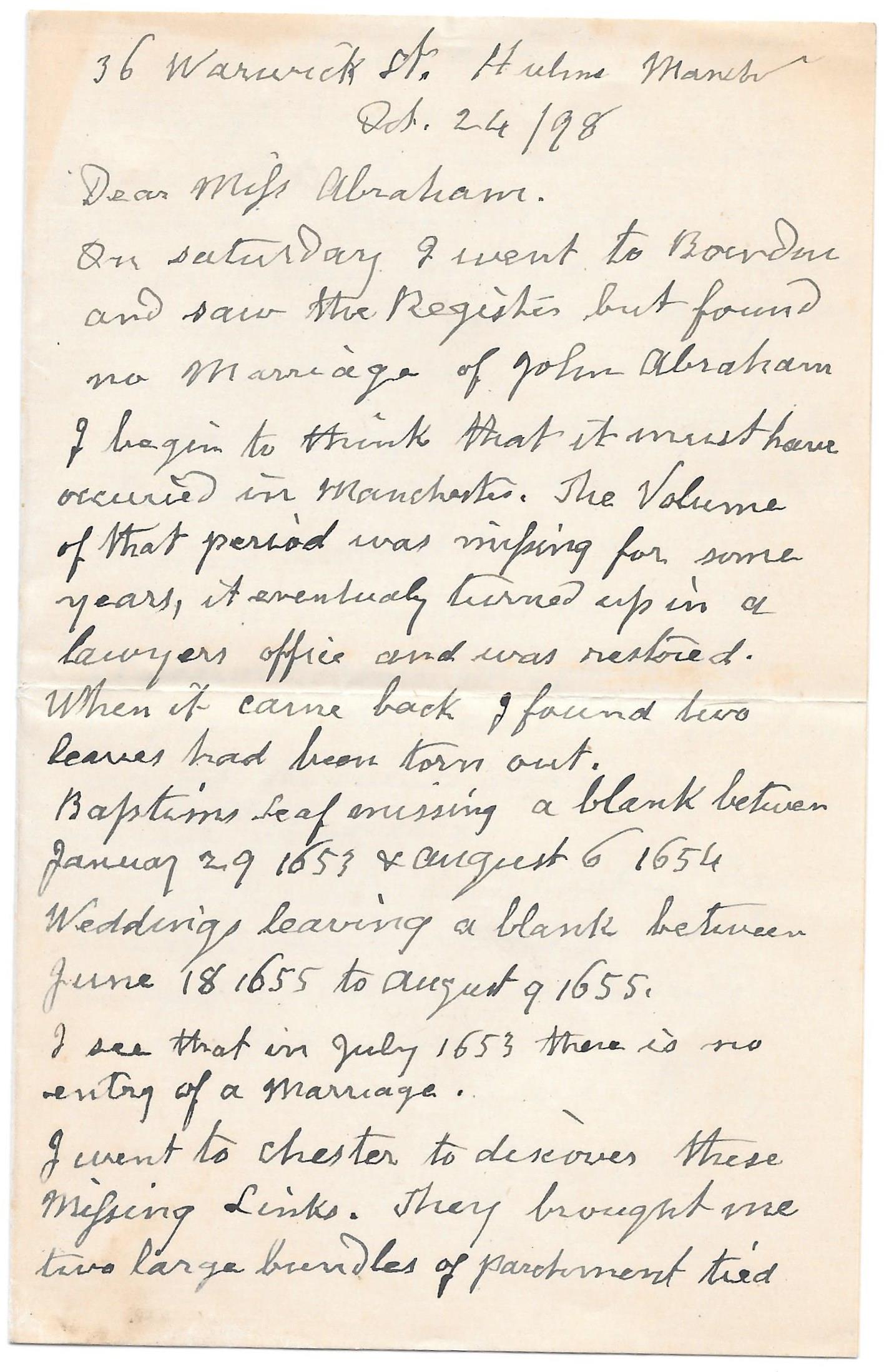 He now says plainly:
I begin to think that it must have occurred in Manchester.
This is the most important conclusion in the second letter.
Why?
Because he links that conclusion not simply to intuition, but to the condition of the Manchester records.
3. History of the missing Manchester volume
He explains that the relevant Manchester volume had been missing for some years, then eventually turned up in a lawyer’s office and was restored. But when it came back, two leaves had been torn out.
He then specifies the gaps:
- Baptisms: blank between 29 January 1653 and 6 August 1654
- Weddings: blank between 18 June 1655 and 9 August 1655
He also notes that there is no entry of a marriage in July 1653.
Meaning
This is crucial. Owen is giving a near-forensic description of the surviving and missing record sequence.
For the Abraham search, the marriage gap in June–August 1655 is especially significant. If John Abraham married during that interval, the record could simply have been on one of the lost leaves.
His note about July 1653 is also interesting. It may mean he had been considering whether the marriage could have been earlier than 1655, but he found no evidence there either.
4. Chester search for missing links
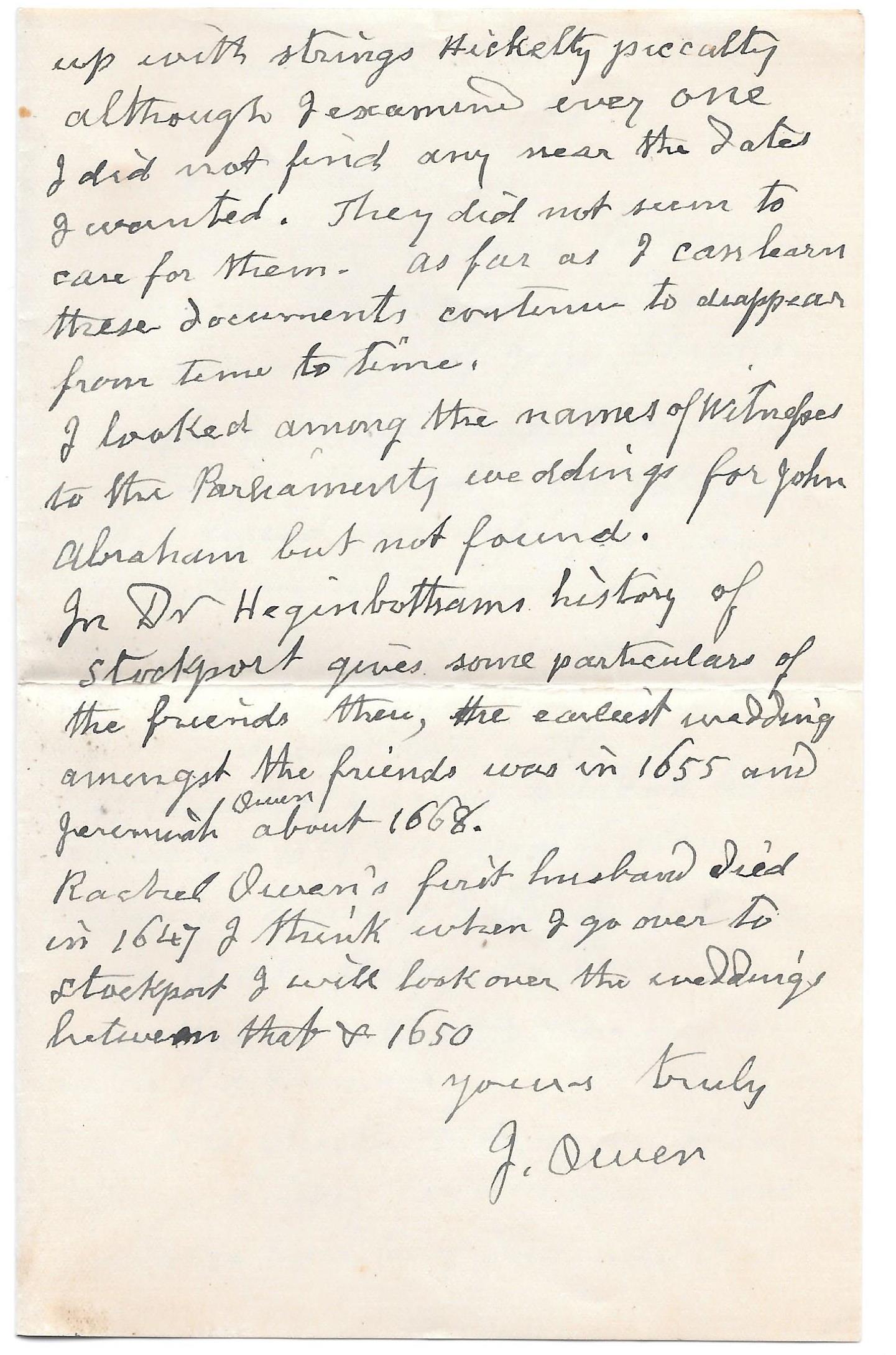 He says he went to Chester to discover the missing links. He was shown two large bundles of parchment, thickly covered with dust, which he examined one by one, but he found nothing near the dates he wanted.
He adds that those in charge “did not seem to care for them” and that as far as he can learn, these documents “continue to disappear from time to time.”
Meaning
This is a striking comment on archival neglect in the late 19th century.
It implies:
- Owen suspected that supplementary or related records in Chester might preserve missing material.
- He carried out an exhaustive manual search.
- He was frustrated not only by the absence of results, but by poor custodianship.
Historically, this is important evidence about the state of record keeping. Genealogically, it means he tried an alternative repository and still did not recover the missing marriage.
5. Witnesses to parliamentary weddings
He says he looked among the names of witnesses to the Parliamentary weddings for John Abraham, but did not find him.
Meaning
This is quite a sophisticated move. Even if John Abraham was not one of the marrying parties in an accessible surviving entry, he might have appeared as a witness in allied family marriages. Owen checked this and found nothing useful.
That means he was testing not only direct but also indirect evidence.
6. Dr Heginbotham’s history of Stockport and the Friends
He refers to Dr Heginbotham’s history of Stockport, which gives particulars of the Friends there. He says the earliest wedding among the Friends was in 1655, and mentions Jeremiah Owen about 1668.
Meaning
This seems to indicate Owen was also considering whether the family had a Quaker / Friends connection.
That matters because if John Abraham belonged to the Friends, his marriage might not appear in the expected Anglican parish register in the usual way.
However, Owen seems to suggest that the Friends evidence in Stockport begins too late, or at least does not clearly help with John Abraham.
7. Rachel Owen again
He writes:
Rachel Owen’s first husband died in 1647 I think when I go over to Stockport I will look over the weddings between that & 1650
This directly links back to the first letter’s notes:
- Rachel Owen married Thomas Wood in 1640
- Thomas Wood was buried in 1647
Owen is now clearly considering whether Rachel Owen remarried between 1647 and 1650, and whether this may matter to the Abraham line.
Meaning
He is pursuing a hypothesis that one branch of the Owen family may connect to John Abraham through a second marriage or associated kinship. This is still tentative, but it is clearly one of his active working theories.
What the two letters show when read together
Together, the letters document a live genealogical investigation moving from broad search to focused hypothesis.
Main conclusions Owen had reached
1. The marriage of John Abraham had not been found in the obvious places
He searched or checked:
- Stockport
- Bowdon
- Manchester extracts
- Parliamentary marriages
- Chester-linked materials
and still had no direct hit.
2. Manchester had become the leading candidate
By the second letter, Owen increasingly believed the marriage must have occurred in Manchester.
3. The missing Manchester register leaves are central
This is probably the single most important point in both letters.
The missing leaves create:
- a baptism gap in 1653–1654
- a marriage gap in 1655
That means the failure to find John Abraham’s marriage is entirely compatible with it having once been recorded there.
4. Other lines remained under review
Owen was still checking:
- Quaker / Friends possibilities
- related Owen family marriages
- High Greave property evidence
- possible Essex / Green connections
So the search was not closed, only narrowed.
People and subjects mentioned
Mrs E. C. Abraham
The recipient. Almost certainly the family researcher or family representative commissioning or corresponding with Owen.
John Abraham
The key ancestor being researched. The specific object is to locate his marriage and place him properly within the family and property history.
J. Owen
The researcher. He is methodical, mobile, honest about uncertainties, and evidently experienced in working with registers and local history.
Rachel Owen
A potentially important woman in the reconstruction. Her first marriage and widowhood may connect to the Abraham line Owen is exploring.
Thomas Wood
Rachel Owen’s first husband, apparently buried in 1647.
Joseph J. Green
A correspondent from Tunbridge Wells whose list of forefathers may connect with the family’s broader kinship network.
John Abraham’s will
Not quoted in full here, but clearly already known to Owen and central to the High Greave analysis.
Archival value of the letters
These letters are valuable not only for genealogy but for archival history.
They preserve near-contemporary testimony that:
- registers were incomplete
- leaves had been torn out
- some volumes had gone missing into private hands
- auxiliary parchments were dusty and poorly cared for
- records could disappear repeatedly
So even where Owen found nothing, his letters supply an explanation for why the evidence may no longer survive.
Best historical reading of Owen’s position
By October 1898, Owen seems to be saying, in effect:
I have searched the most likely alternative parish and associated records without success. I now suspect the marriage was in Manchester, but the relevant Manchester register is defective because leaves are missing. Therefore the marriage may once have been there, but the surviving books can no longer prove it directly.
That is the central message of the correspondence.
Practical evidential takeaway
If you are using these letters as evidence in a family reconstruction, the safest conclusion is:
- They do not prove where John Abraham married.
- They do provide strong contemporary research testimony that the marriage may have been in Manchester and that surviving record loss may be the reason it cannot now be found.
- They also show active consideration of Stockport, Bowdon, Eccles, Stretford, Quaker records, and associated Owen-family links.
So these letters are best treated as important negative-search evidence plus contextual archival evidence, rather than proof of the marriage itself.
Transcriptions
Letter 1 (full transcription):
36 Warwick St. Hulme Manchester
Sept 19th 1898
Dear Mrs Abraham,
I have been to Stockport to examine the Register & and the Clerk looked from 1654 to 1656.
We waded through a long list of the parliamentary weddings with no result. I have examined what I have of extracts from Register records Manchester but find no John Abraham. It would require a special search around. At the time I made the extracts I had no knowledge of your ancestor John Abraham, I might have overlooked it.
You will remember I had a note from Joseph J Green of Tunbridge Wells, he sent me a list of his forefathers but without any dates.
In looking over my extracts from Ashton super Mersey I found in the burials 1772 May 31 Elizabeth Annan Widow, daughter to Thomas Green late of Barking in Essex.
Manchester Registers
1599 Elizabeth Owen & Arthur Gregory Nov. 29
1661 Thomas Owyne & Elizabeth Shelmerdyne May 2
1640 Rachel Owen & Thomas Wood Hayes per l. Jan. 29 X
Samuel Owen & Ales Travers Oct. 24
1651 Lawrence Owen & Esther Trafford Dec. 15
1654 Peter Owen of Manchester Chapman son of Lawrence Owen of Heaton Norris Yeoman & Susan Burgess of Salford Dau. of William Burgess late of the same deceased Witness John Locke, Ales Locke, Samuel Owen, John Owen July 26.
I find in the baptisms 1617 Rachel Dau. of Thomas Owen bap. July 25th
1575 Thomas ye sonne of William Owyne bap. January 25
X I find a burial of a Thomas Wood June 28 1647
There was a leaf torn out of the Manchester Register leaving a blank between June 18 & August 9 1655
1774 March 30 The Reverend John Green L.L.B. Rector of this Church
As the Green family lived in Essex, it is possible there may be a connection.
I have been again to Higho Greave and noticed that the bonding of the brickwork of the front of the old house is what is called bond [sketch] while at the back it was one course of headers to four of stretchers.
The oldest bonding I have seen is at the Morehenn Hall near Charlton cum Hardy, it is one course of headers & one of stretchers. I went up the hill to look at the higher house but found nothing earlier than what I said before viz 1730. It seems to have been built or rebuilt about that time. I found nothing older even in the outbuildings & in the will of John Abraham he mentions his tenement called the lower house at the High Greave which seems to indicate the existence of the higher house in 1661.
Probably it may have been taken down & rebuilt as a residence with stables. I did not notice any shippon, the lower house was amply provided on that score.
How have you got through the hot weather, many people have been prostrated but I have been wonderfully well, but I recovered from the shock of the fall. Though it put me in despair at the time I intended to go to High Greave. After the 2nd time I had a walk round to survey the neighbourhood. I felt terribly tired the next morning which put me in mind of the years 1831 & 2 when I used to walk 36 & 40 miles to see an old church.
I find in the Hexton Register after an entry 26 1651 an erasure, what it was I don’t know, if any portion of it had been visible I should have copied what could be made out.
There is no saying where the marriage of John Abraham may be found there is Eccles, Stratford & Bowdon at the latter an index is kept.
Yours truly
J. Owen