
Eliza Strange of Sturminster Newton: Probate, a Deathbed Gift and a Disputed Box of Money and Jewellery, 1885
In April 2026, I obtained a small group of original probate documents relating to Eliza Strange (née Ambrose) (1813 – 1885), a widow of Sturminster Newton, Dorset, who died in September 1885. At first glance, the bundle looked like a modest piece of Victorian estate administration: a probate grant, an estate account, several solicitor’s letters, and related papers. Yet careful reading revealed that these documents were not merely routine. They preserved the edge of a much larger story — one involving illness, family expectation, a lifelong friend, a locked box, bank notes, jewellery, and a county court dispute over whether a dying woman had truly given away part of her property before death.
What began as a probate file became a human story.
The original probate documents:
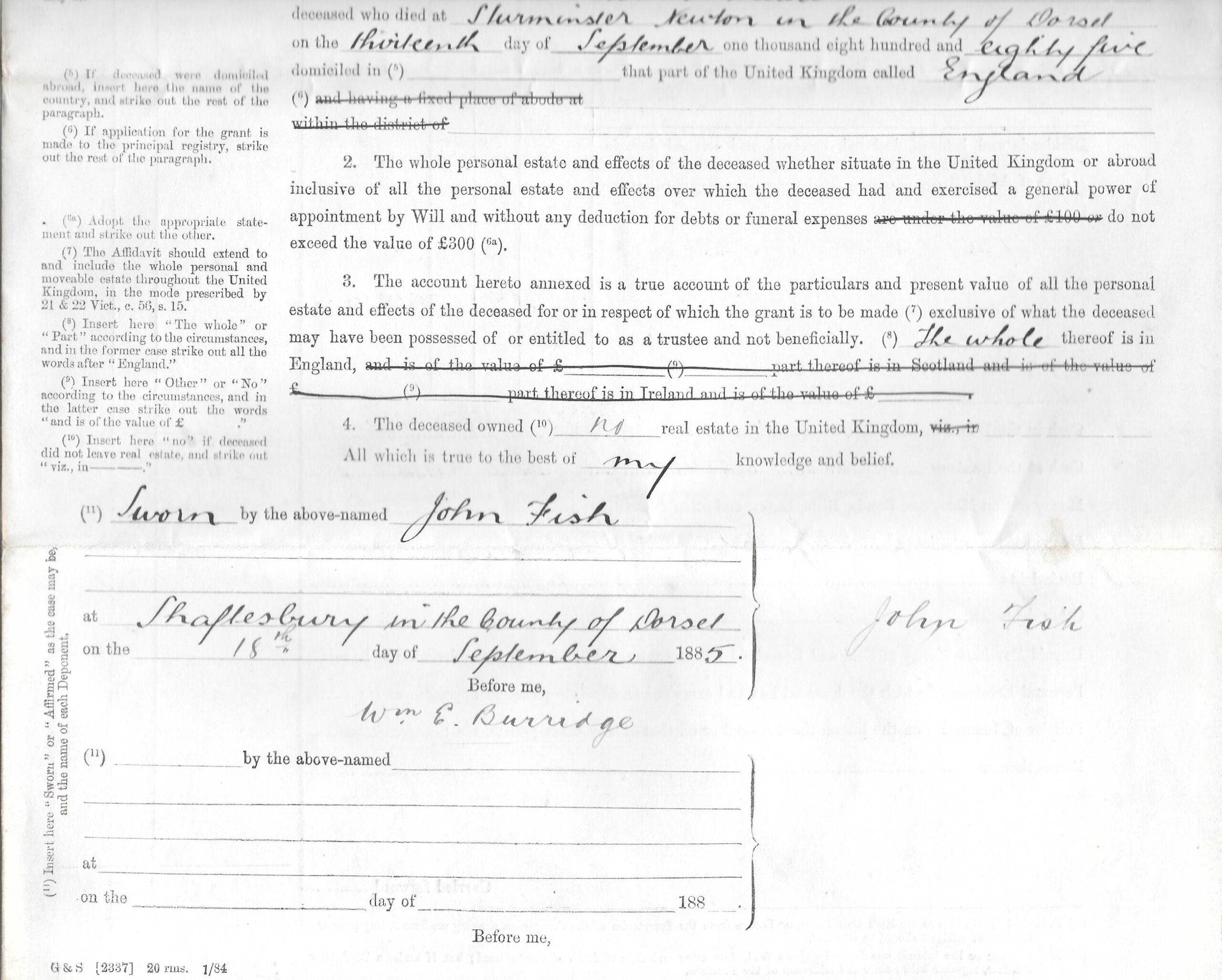
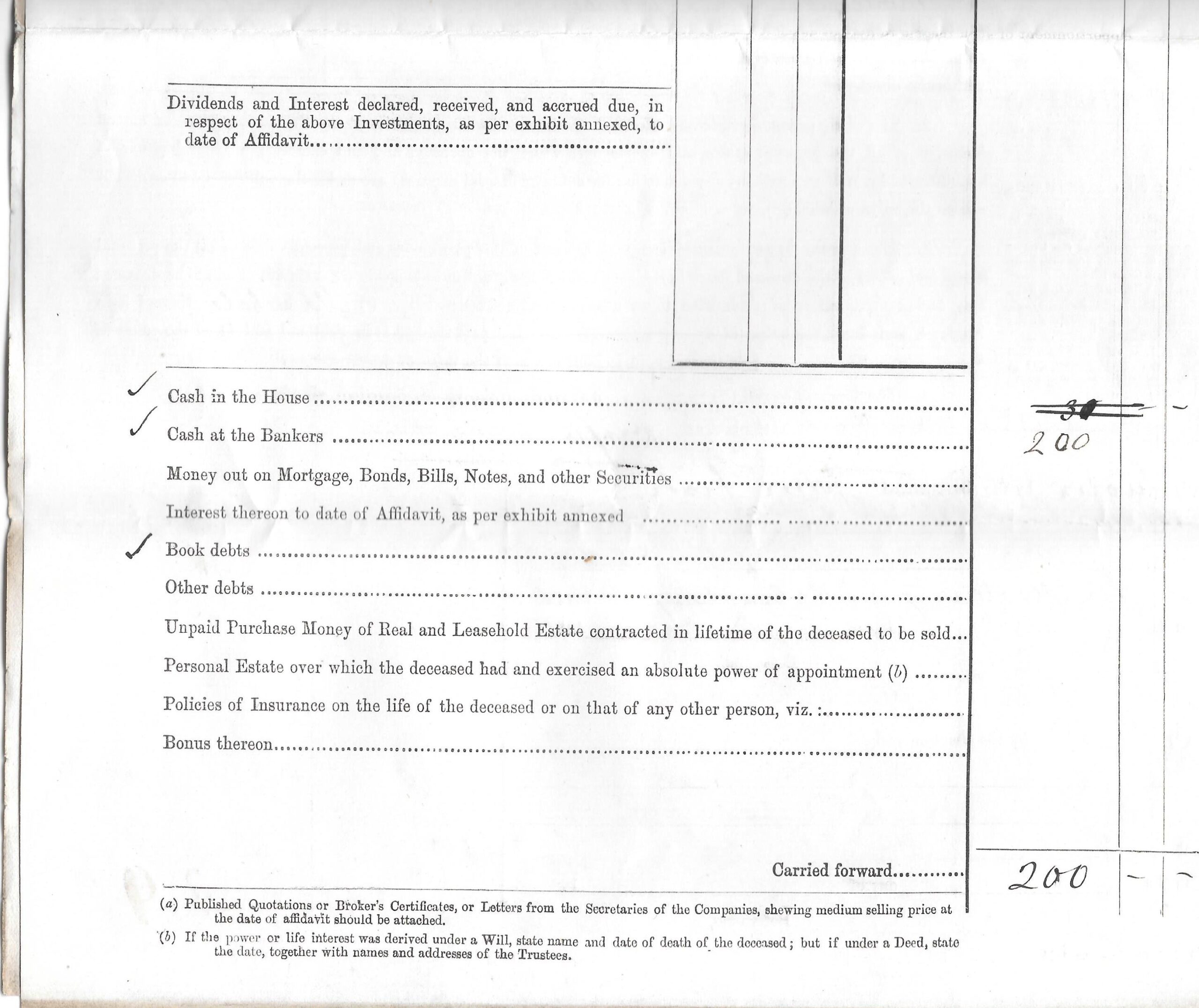
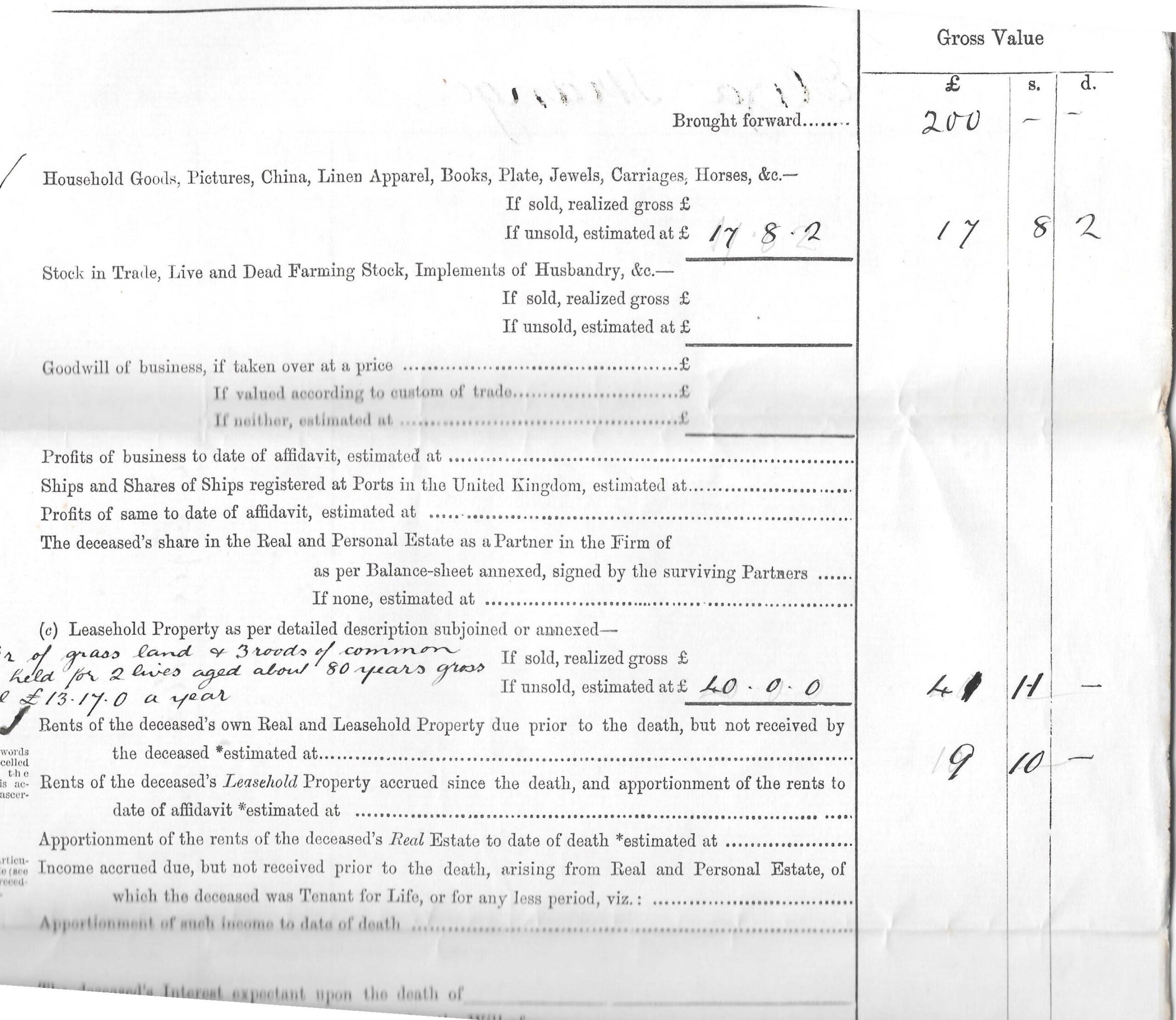
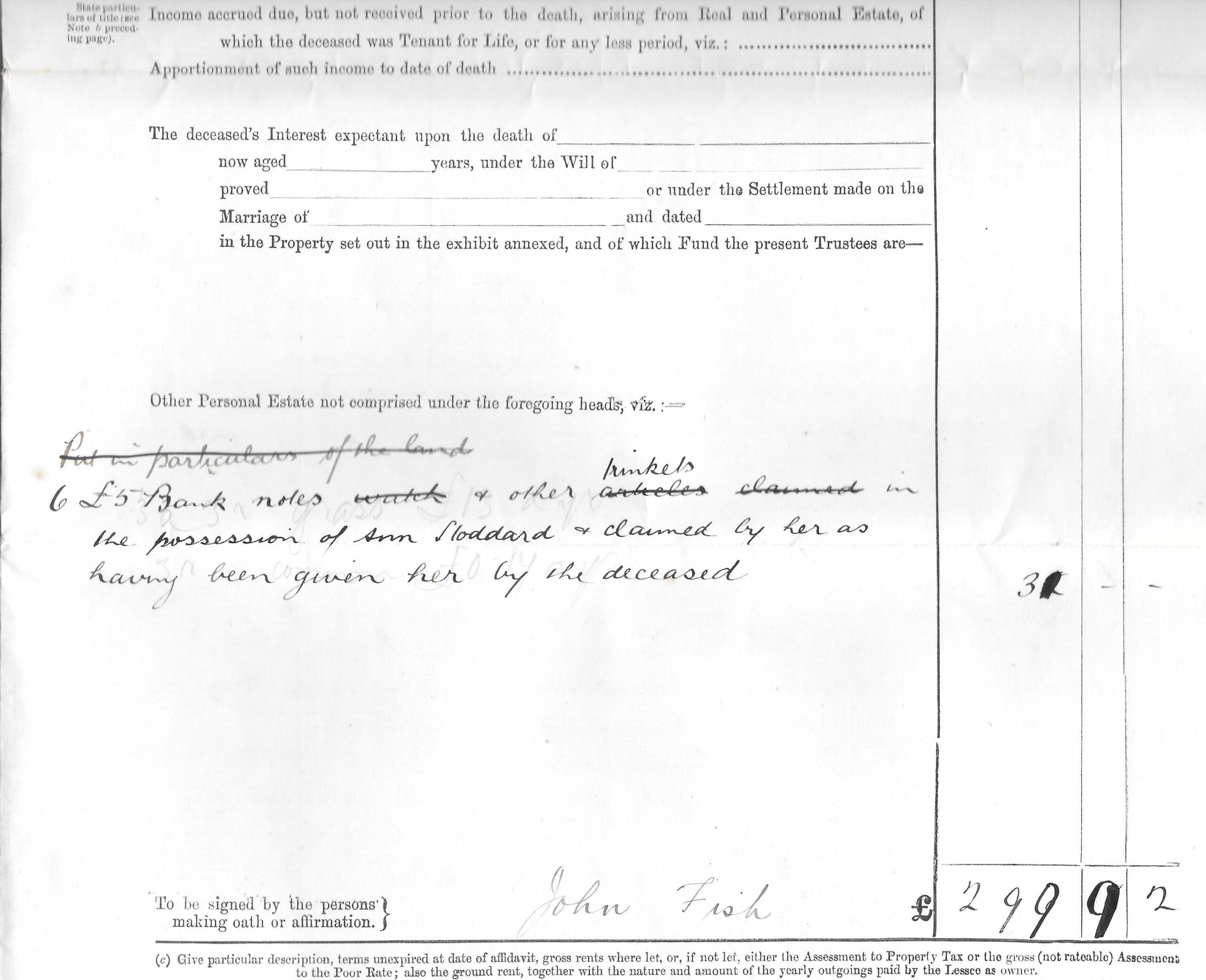
The documents led from the formal world of probate into the sickroom of an elderly Dorset widow, and from there into the Shaftesbury County Court, where witnesses were asked to recall exactly what Eliza Strange said, what she understood, what she intended, and whether the contents of a small box had passed legally and morally into the hands of Ann Stoddard, her old friend and carer.
This page reconstructs the case from the surviving probate papers, the official grant, the will, the death registration details, solicitor’s correspondence, the estate account, and the contemporary newspaper report of the court proceedings.
Eliza Strange: the woman at the centre of the case
Eliza Strange died at Sturminster Newton on 13 September 1885. Her death registration records her as:
Eliza Strange
Female
Age 72 years
Widow of John Strange, farmer
Died 13 September 1885, Sturminster
Cause of death: Dropsy, certified by Duncan R. McArthur, M.D.
Informant: R. Mullins, present at the death
Registered: 14 September 1885
The informant, R. Mullins, was almost certainly Rhoda Mullins, the nurse who later gave crucial evidence in the court case. The doctor, Dr Duncan Romaine McArthur, also appears in the court report, where he described Eliza’s condition and gave evidence about her mental capacity during her final illness.

The cause of death, dropsy, is an older medical term generally referring to swelling caused by fluid retention. In the nineteenth century it was often associated with heart, kidney, or liver disease. In Eliza’s case, the court evidence linked her dropsy with heart disease. She had been ill for some time, suffered great pain, and experienced periods when her mind wandered. Yet the evidence also showed that she could be lucid and capable at other times.
That question — whether she was lucid at the precise moment she gave away the box — became the heart of the dispute.
The will of Eliza Strange
Eliza Strange’s will was made on 15 March 1878, more than seven years before her death. It was short, clear, and sweeping.
In it, she revoked all former wills and left all her real and personal estate to her niece:
Emily Fish, wife of John Fish, sawyer, of Shaftesbury / Enmore Green, Motcombe.
The will appointed John Fish, Emily’s husband, as sole executor.
The essential wording was:
“I give devise and bequeath all my real and personal estate whatsoever and wheresoever and over which I shall have a power of disposition or appointment at the time of my decease unto my niece Emily Fish the wife of John Fish of Shaftesbury in the County of Dorset Sawyer her heirs executors administrators and assigns…”
The will was witnessed by:
[Jas. H. / Chas.] Dashwood, solicitor, Sturminster Newton
Arthur J. Rose, clerk to Mr Dashwood, Sturminster Newton
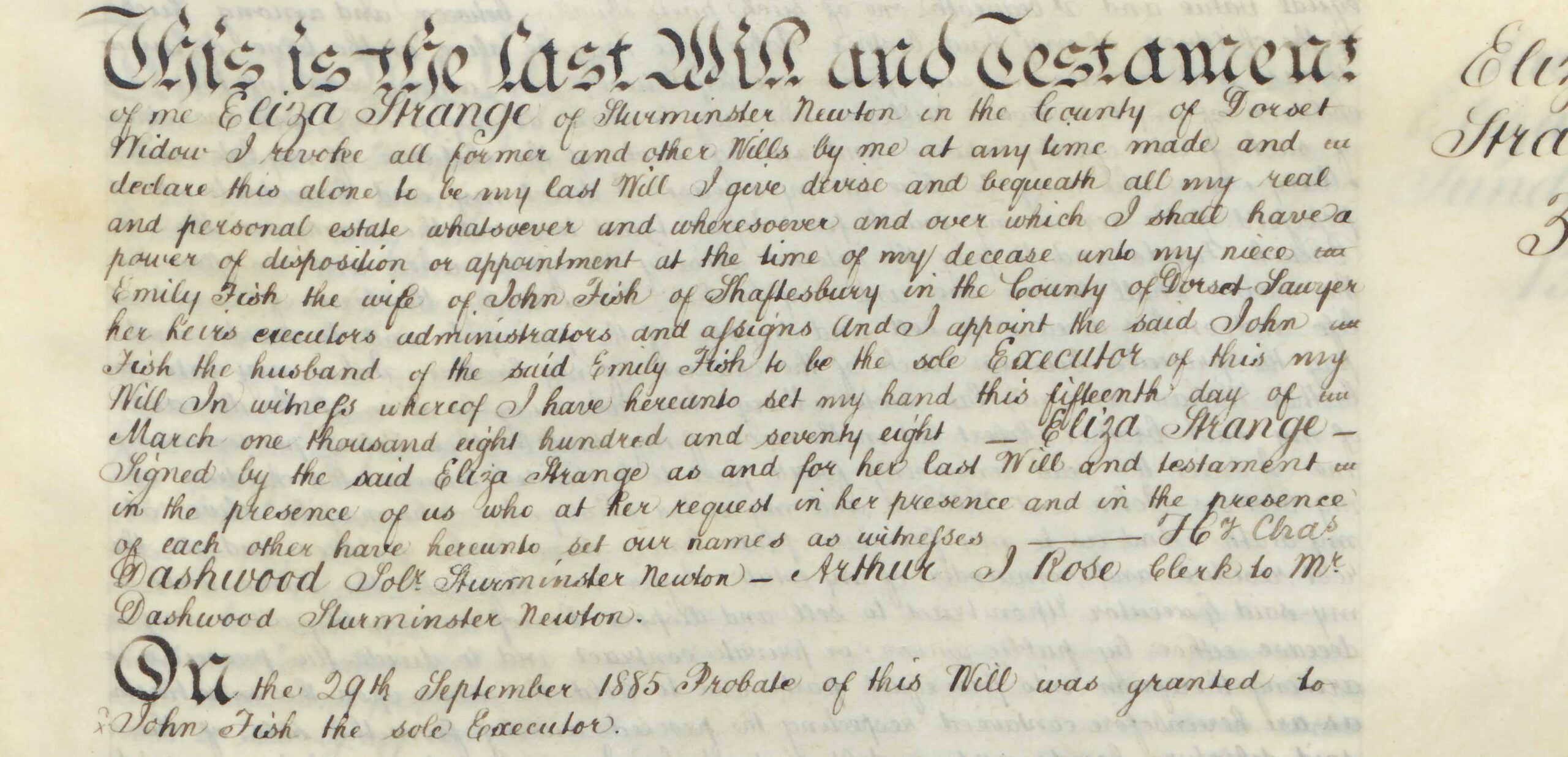
This will is important because it shows the formal legal arrangement: Eliza’s property was to go to Emily Fish, and Emily’s husband, John Fish, was to administer the estate. There was no mention of Ann Stoddard in the will.
That absence later became crucial.
The dispute was not over the will itself. No one appears to have argued that the will was invalid. Instead, the dispute concerned whether Eliza, during her lifetime and shortly before death, had made a valid gift of certain items to Ann Stoddard. If she had, those items no longer belonged to the estate and would not pass under the will. If she had not, they remained estate property and belonged ultimately to Emily Fish under the will.
Probate granted at the Principal Registry
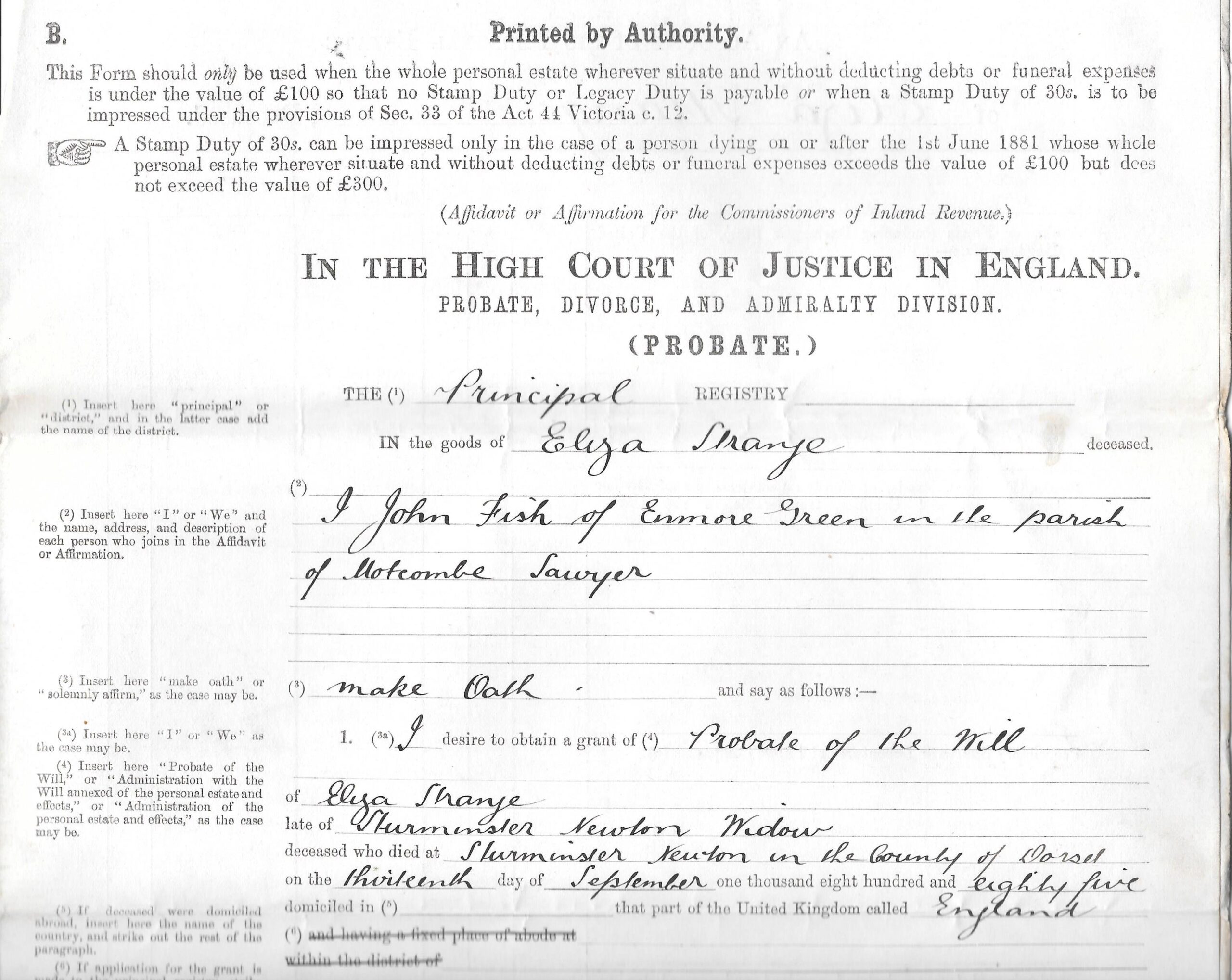
The probate grant confirms that Eliza Strange died on 13 September 1885 at Sturminster Newton, and that probate was granted on 29 September 1885 at the Principal Registry of the Probate Division of Her Majesty’s High Court of Justice.
The grant describes her as:
Eliza Strange late of Sturminster Newton in the County of Dorset Widow
Administration of her personal estate was granted to:
John Fish of Enmore Green in the parish of Motcombe in the said County Sawyer, husband of deceased’s niece Emily Fish, the sole Executor
The gross value of the personal estate was recorded as:
£299 9s. 2d.
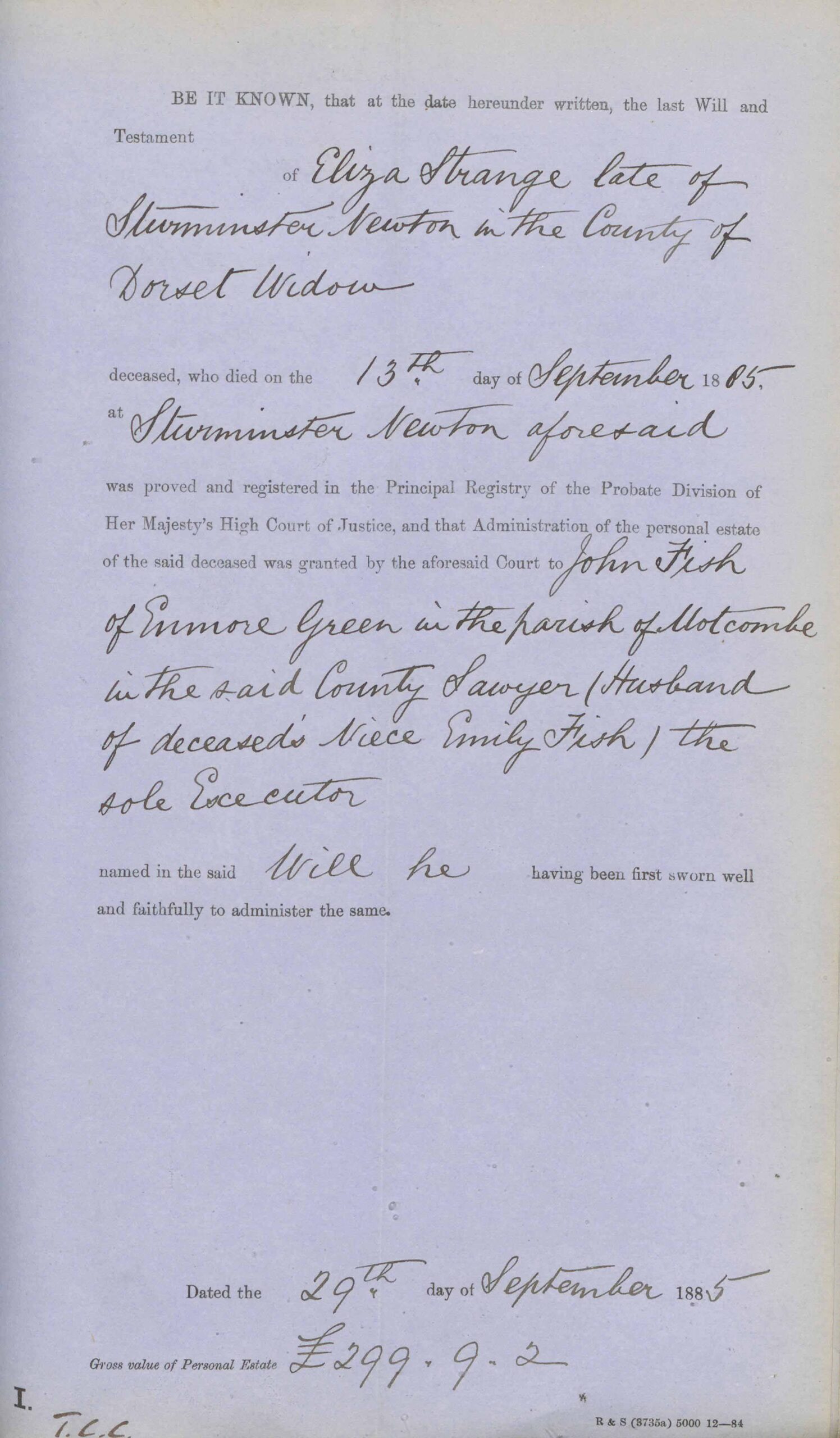
The speed of the process is notable. Eliza died on 13 September. The death was registered the next day. The probate oath was sworn locally on 18 September. Probate was granted in London on 29 September. On paper, the estate appears to have moved efficiently and without formal delay.
But the estate account reveals that one part of the property was already complicated.
The estate account: a modest but significant estate
Eliza Strange’s estate was not large by Victorian standards, but neither was it negligible. The probate papers place it just below the £300 threshold, at £299 9s. 2d.
The estate included:
Cash at the bankers: £200
Household goods and personal effects: £17 8s. 2d.
Leasehold property / land interest: value entered in the estate account
Rents or apportioned rents connected with the leasehold interest
Other personal estate claimed by Ann Stoddard: £30
The form used for the estate account was intended for smaller estates where the personal estate exceeded £100 but did not exceed £300. A stamp duty of 30 shillings applied. This places Eliza’s estate in a very specific category: modest, but sufficiently substantial to require careful legal handling.
The largest clear asset was the £200 at the bank. That was a considerable sum for a widow in a Dorset market town in 1885. The court evidence later confirms that Eliza herself knew there was money “down the town,” meaning at the bank.
Her household goods and personal effects were valued at £17 8s. 2d. The probate form’s printed heading included “Household Goods, Pictures, China, Linen Apparel, Books, Plate, Jewels, Carriages, Horses, &c.” This does not mean she owned every item named in the printed heading; rather, that was the standard category under which her household effects were valued.
There was also a leasehold interest. The handwriting is not entirely easy to read, but it appears to describe grass land and common rights held for two lives, the lives being aged about eighty years, with an annual gross value. This is significant because the affidavit states that Eliza owned no real estate. That is not necessarily contradictory. In nineteenth-century probate practice, leasehold interests were usually treated as personal estate, whereas freehold land was “real estate.” Eliza therefore appears to have had no freehold property, but did possess some leasehold or life-based land interest that was included as part of her personal estate.
Yet the most revealing entry comes at the end of the estate account.
Under “Other Personal Estate not comprised under the foregoing heads,” the document records, in substance:
Six £5 bank notes and other trinkets/articles claimed in the possession of Ann Stoddard and claimed by her as having been given her by the deceased.
The value entered was £30.
This was the clue that opened the whole case.
The probate account did not explain who Ann Stoddard was, why she had the money or objects, whether her claim was accepted, or whether the executor disputed it. It simply recorded the existence of property claimed by her as a gift from Eliza Strange.
The newspaper court report supplied the answer.
The solicitor’s letters: probate administration in motion
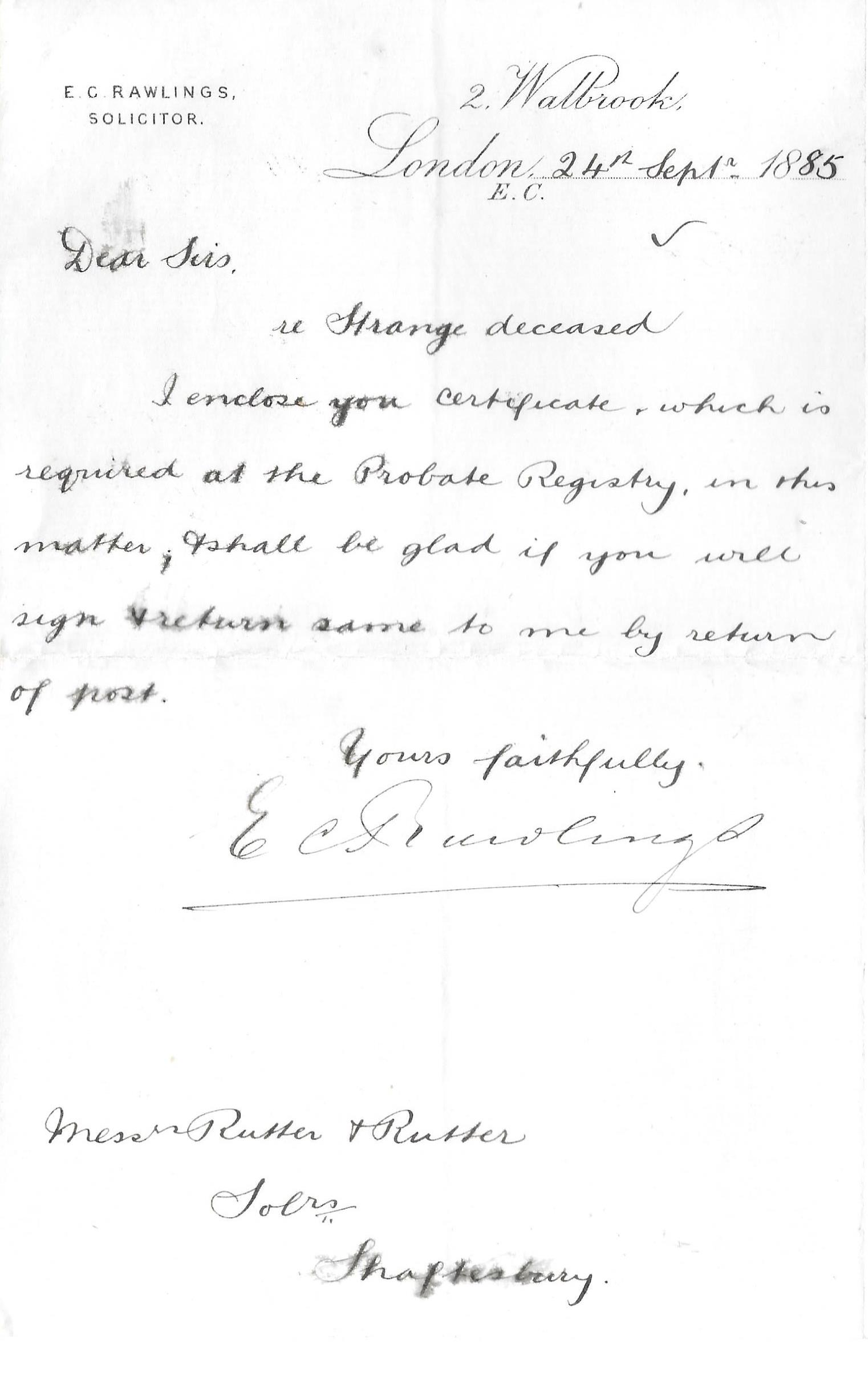
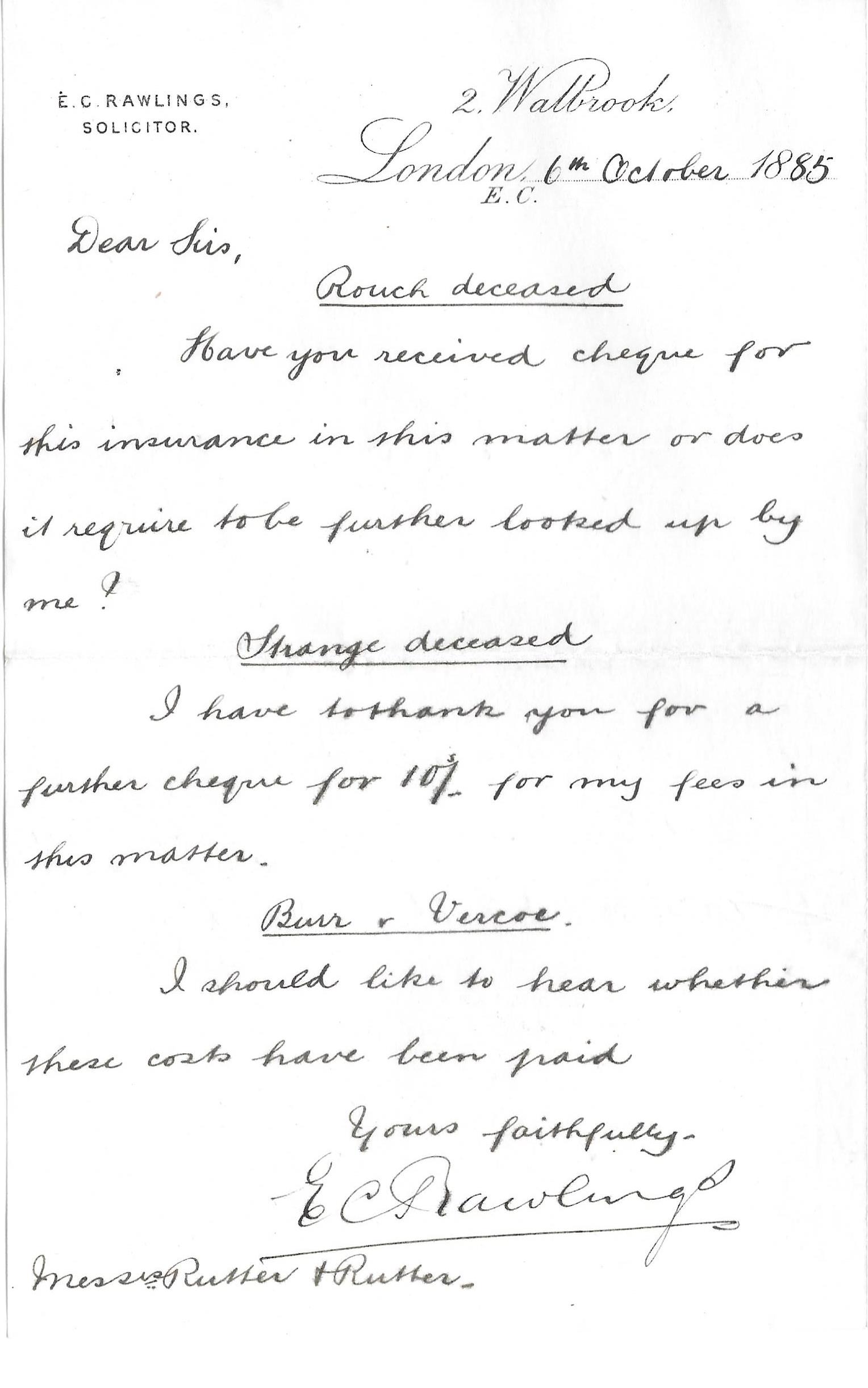
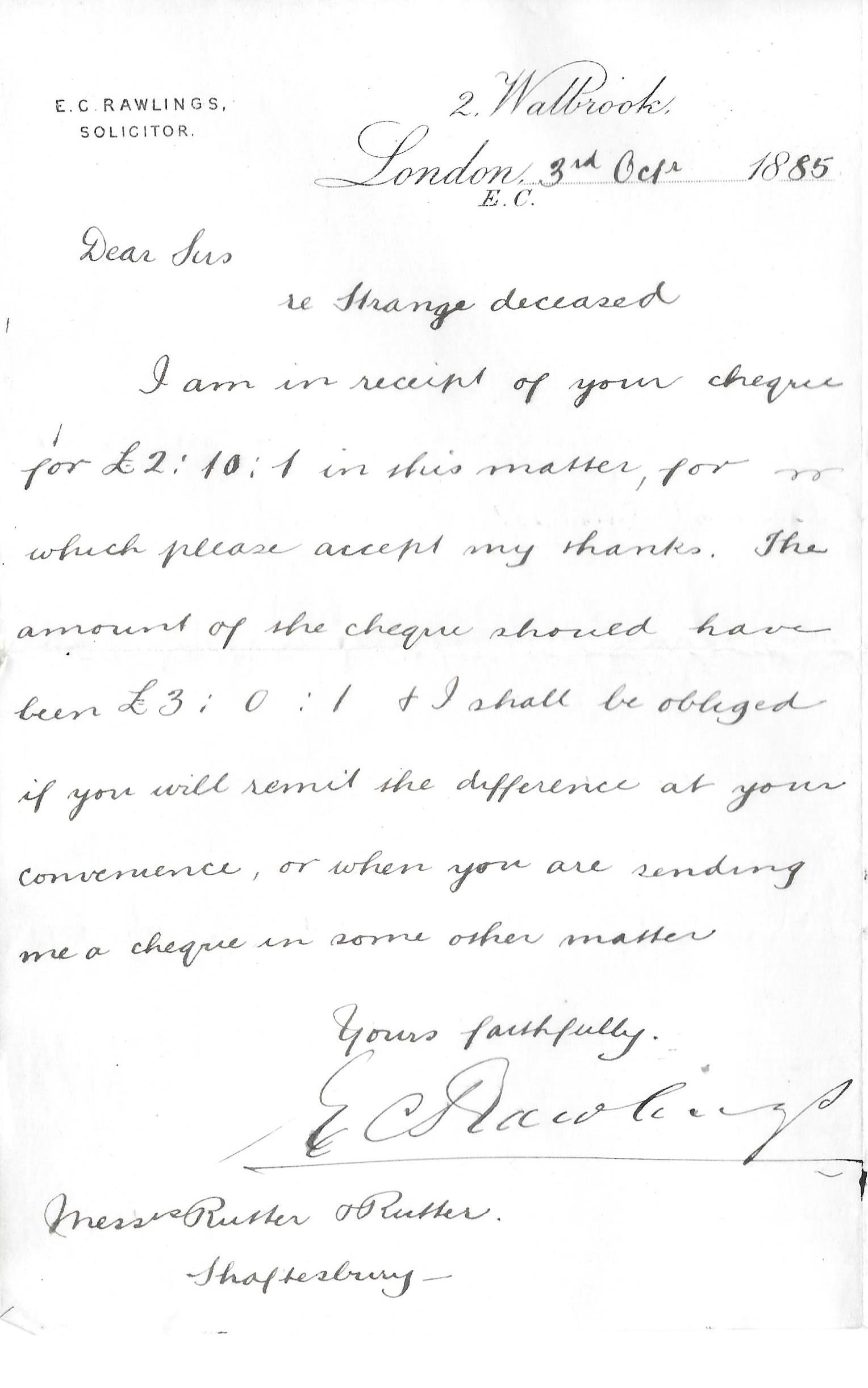
The bundle also includes letters from E. C. Rawlings, solicitor, of 2 Walbrook, London, E.C., to Messrs Butter & Rutter, solicitors, Shaftesbury.
These letters show the probate process as it unfolded.
On 24 September 1885, Rawlings wrote:
“I enclose you certificate, which is required at the Probate Registry, in this matter; I shall be glad if you will sign & return same to me by return of post.”
This shows that, eleven days after Eliza’s death, the formal probate work was still in progress.
On 30 September 1885, Rawlings wrote again:
“I have now the pleasure to enclose the Probate of this will; on the other side I send you a note of my charges in the matter.”
The charges included:
Engrossment – 2s. 6d.
Paid Duty – £1
Court Fees – 15s. 1d.
My Fee / Certificate – 12s. 6d.
The total first sent was £2 10s. 1d.
On 3 October 1885, Rawlings acknowledged receipt of a cheque for that sum but stated that the amount should have been £3 0s. 1d., asking for the difference to be sent when convenient.
On 6 October 1885, he thanked them for a further cheque of 10 shillings, settling the matter.
These letters are routine, but they help to anchor the chronology. Probate had been granted by 29 September and was in the hands of the local solicitors by 30 September. The administrative process was complete. Yet by November, the dispute over the box had reached court.
The newspaper report: the story behind the probate
The full human drama appears in the report of John Fish v. Ann Stoddard, heard at Shaftesbury County Court and printed in the Dorset County Chronicle on 26 November 1885.
The action was brought by John Fish, executor of Eliza Strange, against Ann Stoddard, described as a single woman residing at Sturminster Newton.
The court report says the action was brought to recover:
a certain box with its contents
The contents were listed as:
- six £5 bank notes
- a silver watch and chain
- three brooches
- a pair of gold ear-drops
- a gold fly ornament
- two silver coins
- a silver knife
The total value was stated as £40.
This list is much fuller than the probate account. It tells us that the “trinkets” were not insignificant odds and ends. They included jewellery and personal items, particularly the watch and chain, which later became central to the emotional resolution of the case.
The legal issue: was the box a valid gift?
The legal issue was simple to state but difficult to decide.
John Fish, as executor, claimed that the box and its contents belonged to Eliza Strange’s estate. Since Eliza’s will left everything to Emily Fish, the property should pass under the will.
Ann Stoddard claimed that Eliza had given the box to her before death. If that was true, the property no longer belonged to the estate.
The judge stated that the burden of proof lay with the defendant, Ann Stoddard. That means she had to prove that the gift was real, complete, and made while Eliza was capable of understanding what she was doing.
The case therefore turned on three questions:
Did Eliza Strange intend to give the box to Ann Stoddard?
Was the box actually delivered to her?
Was Eliza mentally capable at the time?
These are classic elements in disputes over alleged deathbed gifts. Such gifts were treated cautiously because they could easily be fabricated, misunderstood, or made when a dying person was weak, frightened, confused, or under pressure. But they could also be entirely genuine. The court had to decide which this was.
Rhoda Mullins: nurse, informant, and key witness
The most important witness was Rhoda Mullins, the nurse who had cared for Eliza Strange for nine months before her death. She was also the person who informed the registrar of Eliza’s death.
Mullins said that on Saturday, 5 September 1885, Eliza called her into the room. Eliza told her to take a small box from a larger box at the foot of the bed. According to Mullins, Eliza ordered that the small box be given to Ann Stoddard, who was not then present.
Mullins did not immediately give it to Stoddard. She said she would do so when Ann came, but did not do so at that time.
On the following Sunday morning, 6 September, Ann Stoddard came to dress Eliza’s leg. Eliza had dropsy, was very ill, and believed she was going to die. She asked Stoddard to stay, as she wished to say something to her, but the conversation did not then take place.
Later that evening, Stoddard returned to sit up with Eliza. Mullins slept downstairs, leaving Eliza and Stoddard together.
During the night, Mrs Strange called Mullins. When Mullins entered the room, she found Eliza and Ann Stoddard together in conversation. Eliza told Mullins to take the key belonging to the large black box, unlock it, remove the small box, and give it to Stoddard. Mullins did not do it then. Stoddard said she did not want it.
Mullins went downstairs again, but Eliza called her back. Eliza said:
“You did not give Miss Stoddard that box. I know you did not, but you shall.”
Again, Stoddard said she did not want it and would not have it.
Mullins still did not give it to her and went back to bed. Soon afterwards, Stoddard came down and said:
“You must come and give me the box or Mrs. Strange will not be satisfied.”
Mullins went upstairs again. Eliza said:
“You shall unlock that box and give the little box to Ann.”
Mullins did so. She put the little box into Miss Stoddard’s hands. Eliza then said she was quite satisfied.
This is the centre of the whole case. According to Mullins, there was a clear instruction from Eliza, hesitation by the nurse, reluctance by Stoddard, repetition by Eliza, and eventual delivery of the little box into Stoddard’s hands.
But there were complications.
Did Ann Stoddard want the box?
One striking aspect of the report is that Stoddard repeatedly said she did not want the box.
This could be read in more than one way.
It could show reluctance, modesty, or emotional discomfort at receiving something from a dying friend. It could also be used against her, suggesting uncertainty about whether she regarded it as a real gift.
The report says that after the box was finally given to her, Stoddard carried it away the same morning. Eliza knew she had carried it away. Before that happened, Mullins asked Eliza whether she knew what she was doing, because she had given away nearly all the money she had in the house. Eliza replied that there was plenty more down the town, meaning at the bank.
That detail is crucial. It connects the court testimony directly with the probate account. The estate papers show £200 at the bank. The court evidence shows that Eliza herself referred to money at the bank when questioned about giving away the money in the house.
This supports the argument that she understood, at least in that moment, that she was not leaving herself entirely without resources.
The key to the box
The key became an important legal detail.
Mullins said that when Stoddard first took the box away, she did not take the key with her. Later, in the evening, Eliza ordered that she should have it, and Stoddard said it was a free gift and that she should keep it.
This mattered because, with a locked box, possession of the box alone might not prove full control if the key remained elsewhere. Counsel for Fish later argued that Stoddard’s failure to take the key at first showed she did not then consider the box a completed gift.
It was a small physical detail, but legally significant. In a deathbed gift case, delivery is everything. A key can become evidence of control.
Eliza’s condition: lucid or incapable?
The court heard substantial evidence about Eliza’s health and mental state.
Rhoda Mullins said Eliza was very ill, had dropsy, and believed she was dying. She also admitted that Eliza had been “flighty or childish at times.” Eliza cried out “murder” when in agony, asked to be thrown from the window when suffering great pain, and was sometimes childish after waking from sleep.
This evidence was damaging to Stoddard’s case, because it suggested that Eliza’s mind was not always reliable.
But Mullins did not say Eliza was always incapable. She said Eliza knew perfectly well about her house affairs. That distinction became essential: a person might be confused at some times and perfectly capable at others.
The medical evidence came from Dr Duncan Romaine McArthur, who had attended Eliza from the middle of June to 11 September. He said she had heart disease with dropsy, and that this might affect her mind. On 7 September she was wandering in her mind at times and not responsible for her actions. But at other times she was responsible, and when she was so, she was perfectly capable of understanding and managing her affairs.
He had seen her on the Monday between twelve and four o’clock and considered her quite responsible for any act then.
This evidence was balanced. It did not prove that Eliza was always capable. It did not prove that she was always incapable. It left the jury to decide whether, at the moment of the gift, she knew what she was doing.
Hannah Elkins and the “handsome present”
Another witness, Hannah Elkins, a charwoman of Sturminster Newton, had sat up with Eliza on Saturday night, 5 September.
She said Eliza told her during the night that she intended to give Ann Stoddard a handsome present, because Ann was a nice kind of woman, and Eliza wondered what she would have done without her.
This evidence was extremely helpful to Stoddard. It showed that Eliza’s intention to reward Ann was not confined to one disputed moment. It had been expressed earlier to another witness.
Hannah Elkins also said Eliza asked her to open her box, take out her will, and break it up. Elkins refused. This is a very revealing detail. It suggests Eliza was thinking not only about the box, but about the will itself. She may have been dissatisfied with the existing testamentary arrangement, or she may have wished to alter it informally because she was too ill or too close to death to make a new will.
Her attempt to have the will destroyed was not legally effective, but it shows the emotional setting of the dispute. Eliza had a will leaving everything to Emily Fish, but in her final illness she was apparently expressing a wish to reward Ann Stoddard and possibly alter the effect of her earlier arrangements.
Ann Stoddard: lifelong friend and carer
Ann Stoddard’s own evidence gave the case its emotional force.
She said she had known Eliza Strange all her life. They had been companions in childhood and had always been very friendly. Eliza was seventy-two when she died; Ann was seventy-five.
During Eliza’s illness, Ann had sat up with her for ten weeks, every other night. She made no charge for doing so, and no payment had been discussed.
This matters greatly. Ann was not a stranger. She was not a paid attendant suddenly making a claim. She was an elderly woman who had known Eliza since childhood and who had cared for her during her final illness without asking for payment.
Her case was therefore both legal and moral. She claimed not merely that the box had been handed to her, but that Eliza had wanted to reward her.
The primitive box
The box itself was produced in court. The judge remarked that it was a very primitive affair, and might belong to the sixteenth century.
This is a vivid detail. The court was not dealing with an abstract estate item, but with a physical object: old, locked, and intimate. It had sat inside a larger black box at the foot of Eliza’s bed. It contained money and personal ornaments. It was the sort of object in which a person kept things that mattered.
The jury examined it and expressed the opinion that none of its contents had been meddled with. This appears to have strengthened Stoddard’s credibility. If she had taken the box and tampered with it, that would have been damaging. The jury evidently did not think that had happened.
The earlier will and the Fish family
The will left everything to Emily Fish, Eliza’s niece. John Fish, Emily’s husband, was executor. This means that the plaintiff in the court action was not a disinterested outsider. As executor, John Fish had a legal duty to recover estate property. But his wife was also the sole beneficiary of the will. The estate’s success would benefit Emily Fish.
That does not mean John Fish acted improperly. On the contrary, as executor, he was entitled — and perhaps obliged — to test Stoddard’s claim if he believed the property belonged to the estate. But the family interest is important context.
The court heard that Emily Fish had visited Eliza on the Saturday before the Monday on which the box was given away. According to Rhoda Mullins, Eliza and Emily seemed on good terms, but after Emily left, Eliza was angry because she had gone. Eliza reportedly said:
“Now she has left me I will do what I like with my own.”
That sentence is one of the most revealing in the entire case. It suggests that Eliza’s act may have been bound up with disappointment, autonomy, and a desire to assert control over her own property at the end of life.
The will represented a decision made in 1878. The box may have represented a decision made in 1885, under the pressure of illness, care, disappointment, gratitude, and impending death.
John Fish’s evidence
John Fish gave evidence as executor. He stated that Eliza had been in the habit of keeping about £20 in the house, and that she had expressed an intention to give £5 to a blind girl and £5 to another person.
This evidence was used to suggest that Eliza’s true intention had not been to give the entire contents of the box to Ann Stoddard. Instead, she had previously contemplated smaller gifts to others.
Fish also said he went weekly to lift Eliza out of bed, and had been there about a fortnight before she died. He had not seen her at night.
His evidence therefore presented him not only as executor but as someone who had been involved in Eliza’s care. Still, he was not present during the crucial night-time events when the box was allegedly given.
Emily Fish and the watch and chain
Emily Fish, wife of John Fish and niece of Eliza Strange, gave important evidence.
She said that when she visited Eliza on the Thursday before her death, Eliza did not know her at first. This supported the argument that Eliza’s mental state could be uncertain.
Emily also said that Eliza made her read the will and told her she was to have a watch and chain which was in the box, asking her to promise to wear it for Eliza’s sake.
This detail is deeply important. It suggests that even if Eliza gave the box generally to Ann Stoddard, she may still have had a specific wish about one item inside it — the watch and chain. That helps explain the ending of the case, when Stoddard agreed to give up the watch and chain to Mrs Fish.
In other words, the legal ownership of the whole box and the moral destination of one particular item were not necessarily identical.
Julia Scott’s evidence
Julia Scott was also called. The newspaper report says she fully confirmed the evidence of Mrs Mullins and Miss Stoddard, and added that when Mullins told Eliza that she had given the box to Miss Stoddard, Eliza said that was all right.
This was another important piece of evidence in favour of Stoddard. It showed Eliza confirming the gift after the act had been done.
Counsel’s argument for the executor
Mr Rutter, representing John Fish, argued that Stoddard’s failure to take the key at first showed that she did not then consider the box a gift to her.
He also argued from the medical evidence. Eliza was not always answerable for her actions. She was flighty at times. The wish to give the box to Stoddard may have been expressed when Eliza was in that condition.
He further argued that the gift was contrary to Eliza’s previously expressed intentions: to give £5 to a blind girl, £5 to another person, and to keep enough money in hand for funeral expenses.
The argument was therefore clear:
Eliza’s will gave everything to Emily Fish.
Her known prior intentions involved smaller gifts, not the whole box.
Her mind was unreliable at times.
The box was not clearly delivered with the key at first.
Therefore the alleged gift was not proved.
It was a strong argument, but it did not succeed.
The judge’s questions to the jury
The judge put two questions to the jury:
Was the box a free gift to Miss Stoddard?
Was the deceased, when she gave it, in such a state of mind as to be capable of knowing what she was about?
The foreman said the jury had already agreed.
Their answer was that the box and its contents were a free and absolute gift, and that when Eliza gave them to Miss Stoddard she was perfectly capable of knowing what she was about.
The judge therefore said:
“That is a verdict for the defendant.”
This is legally consistent. John Fish, as plaintiff, was trying to recover the box for the estate. Ann Stoddard, as defendant, said it had been given to her. The jury accepted her defence. Therefore the verdict was for Stoddard.
The ending: law, conscience, and applause
After the verdict, Miss Stoddard was appealed to about what she would do with the contents of the box.
She said she would pay her own solicitor’s fee and, with the advice of a friend, consider what to do with the contents. But she agreed to give up the watch and chain to Mrs Fish.
The court responded with loud applause.
The judge said:
“That is acting like a true Christian woman respecting the dying wishes of a friend.”
This ending is remarkable. Stoddard had won the legal case. The box and its contents were found to have been given to her. Yet she was willing to surrender the watch and chain to Emily Fish, apparently recognising Eliza’s specific wish that Emily should have that item.
The applause suggests that those present saw this as an honourable compromise: Stoddard retained her legal victory, but acknowledged a moral obligation.
The probate contradiction that is not really a contradiction
At first glance, there is tension between the probate account and the court verdict.
The probate account includes the six £5 bank notes and other items in the estate valuation, while noting that they were claimed by Ann Stoddard. The court later found that the box and contents were a valid gift to Stoddard.
The most likely explanation is timing and caution.
When the probate account was prepared, the executor had to account for property that might belong to the estate. The notes and trinkets were disputed. They were therefore entered, but with the important qualification that they were in Ann Stoddard’s possession and claimed by her as a gift from the deceased.
Later, the county court resolved the issue in Stoddard’s favour.
The probate papers therefore preserve the estate-side position before the dispute was finally decided. The newspaper report preserves the courtroom resolution.
Together, they give a fuller story than either source alone.
What this case tells us about deathbed gifts
This case is a valuable example of a Victorian dispute over an alleged deathbed gift.
The central issues were:
Intention — Did Eliza mean to give the box to Ann?
Delivery — Was the box actually handed over?
Acceptance — Did Ann accept it?
Capacity — Did Eliza know what she was doing?
Control — Did possession of the box and key pass sufficiently?
Consistency — Did the gift fit with Eliza’s previous intentions and will?
The jury answered these questions in favour of Ann Stoddard.
The evidence that probably mattered most included:
- Eliza’s repeated instructions that Ann should have the box
- the physical placing of the box in Ann’s hands
- Eliza’s statement that she was satisfied afterwards
- Hannah Elkins’s evidence that Eliza intended to give Ann a handsome present
- Julia Scott’s confirmation that Eliza approved the gift
- the doctor’s evidence that Eliza had lucid intervals and could be capable
- the fact that Eliza knew she still had money at the bank
- the jury’s view that the box had not been tampered with
Against that stood:
- Eliza’s fluctuating mental condition
- her earlier will in favour of Emily Fish
- the initial absence of the key
- the previous intention to give smaller sums to others
- Emily Fish’s claim about the watch and chain
- Eliza’s episodes of confusion, pain, and distress
The jury nevertheless found that the gift was genuine and valid.
The people in the story
Eliza Strange
A widow of Sturminster Newton, aged 72, formerly wife of John Strange, farmer. She died of dropsy on 13 September 1885. Her final illness involved pain, swelling, weakness, and periods of mental wandering. Yet the evidence suggests she also had lucid intervals and continued to think actively about her property, her will, and those who cared for her.
Ann Stoddard
A single woman of Sturminster Newton, aged about 75, lifelong friend and childhood companion of Eliza. She sat up with Eliza every other night for ten weeks without charge. She claimed the box and contents had been given to her by Eliza. The jury accepted her claim.
John Fish
Sawyer, of Enmore Green in the parish of Motcombe. Husband of Emily Fish, Eliza’s niece. Sole executor of the will. He brought the action to recover the box and contents for the estate.
Emily Fish
Niece and sole beneficiary under Eliza’s will. Wife of John Fish. She claimed Eliza had intended her to have the watch and chain from the box. After the verdict, Ann Stoddard agreed to give up the watch and chain to her.
Rhoda Mullins
Nurse to Eliza for nine months before death. Present at the death and informant on the death registration. Key witness in the court case. Her evidence described the actual transfer of the box.
Dr Duncan Romaine McArthur
Medical practitioner who attended Eliza from June to September 1885. Certified the cause of death as dropsy and gave evidence about Eliza’s physical and mental condition.
Hannah Elkins
Charwoman of Sturminster Newton. Sat up with Eliza and gave evidence that Eliza intended to give Ann Stoddard a handsome present.
Julia Scott
Witness who supported the evidence of Mullins and Stoddard and said Eliza confirmed that giving the box to Ann was “all right.”
E. C. Rawlings
Solicitor of 2 Walbrook, London, who handled the Principal Registry side of the probate.
Butter & Rutter
Shaftesbury solicitors involved in the local handling of the probate matter.
Why the case matters
This is a small case, but it is rich in meaning.
It shows how a routine probate record can conceal a much deeper story. The official grant simply tells us that Eliza Strange died, that her estate was valued at £299 9s. 2d., and that John Fish proved the will. The will tells us that everything was left to Emily Fish. The estate account hints at a dispute. The solicitor’s letters show the probate machinery moving. The death certificate gives the medical and registration facts. The newspaper report opens the sickroom door and allows us to hear the voices of those who were there.
The case also reveals the tension between formal testamentary law and last-minute personal intention. Eliza’s will was seven years old. Her final illness created new emotional circumstances. She had been cared for by Ann Stoddard, an old friend who had sat up with her for weeks without payment. Eliza may have wanted to reward that care in a direct and personal way, without rewriting the will.
The law had to decide whether that act was valid.
The jury decided that it was.
A recovered Dorset story
When I obtained the probate documents in April 2026, the story was not immediately visible. The papers had to be read closely. The estate account had to be understood. The cryptic note about Ann Stoddard had to be followed. The newspaper report had to be found and connected to the probate file. The death registration and will then gave the story its final structure.
The result is a rare, layered archive case in which several types of source interlock:
- the death registration
- the will
- the probate grant
- the estate account
- the solicitor’s letters
- the public probate notice
- the county court report
Together, these documents reconstruct not merely an estate, but a dispute over memory, care, intention, and property.
Eliza Strange’s probate was not just a legal file. It was the paper trail of a final act: an elderly widow, dying in Sturminster Newton, attempting to give a small box of money and personal possessions to the woman who had helped care for her. The executor challenged that gift. A jury heard the evidence. Ann Stoddard won. And then, in an act that brought applause in court, she agreed to surrender the watch and chain to Emily Fish, honouring what was understood to be one of Eliza’s final wishes.
That is why this archive matters.
It preserves the formal record — but also the human drama behind it.
Dorset County Chronicle – Thursday 26 November 1885
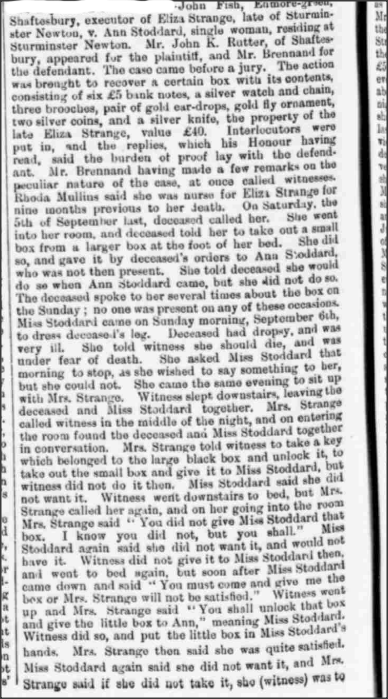
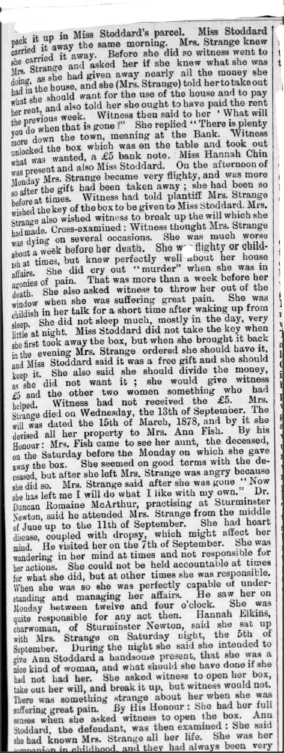
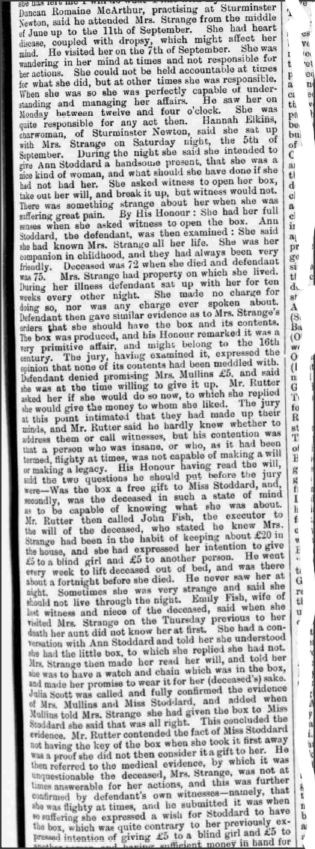
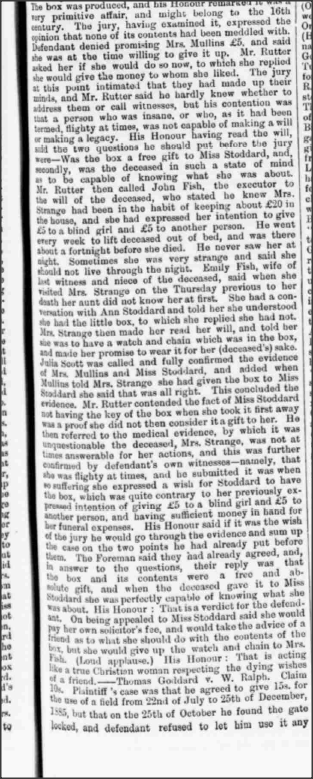
John Fish, Enmore-green, Shaftesbury, executor of Eliza Strange, late of Sturminster Newton, v. Ann Stoddard, single woman, residing at Sturminster Newton. Mr. John K. Rutter, of Shaftesbury, appeared for the plaintiff, and Mr. Brennand for the defendant. The case came before a jury. The action was brought to recover a certain box with its contents, consisting of six £5 bank notes, a silver watch and chain, three brooches, pair of gold ear-drops, gold fly ornament, two silver coins, and a silver knife, the property of the late Eliza Strange, value £40. Interlocutors were put in, and the replies, which his Honour having read, said the burden of proof lay with the defendant. Mr. Brennand having made a few remarks on the peculiar nature of the case, at once called witnesses. Rhoda Mullins said she was nurse for Eliza Strange for nine months previous to her death. On Saturday, the 5th of September last, deceased called her. She went into her room, and deceased told her to take out a small box from a larger box at the foot of her bed. She did so, and gave it by deceased’s orders to Ann Stoddard, who was not then present. She told deceased she would do so when Ann Stoddard came, but she did not do so. The deceased spoke to her several times about the box on the Sunday ; no one was present on any of these occasions. Miss Stoddard came on Sunday morning, September 6th, to dress deceased’s leg. Deceased had dropsy, and was very ill. She told witness she should die, and was under fear of death. She asked Miss Stoddard that morning to stop, as she wished to say something to her, but she could not. She came the same evening to sit up with Mrs. Strange. Witness slept downstairs, leaving the deceased and Miss Stoddard together. Mrs. Strange called witness in the middle of the night, and on entering the room found the deceased and Miss Stoddard together in conversation. Mrs. Strange told witness to take a key which belonged to the large black box and unlock it, to take out the small box and give it to Miss Stoddard, but witness did not do it then. Miss Stoddard said she did not want it. Witness went downstairs to bed, but Mrs. Strange called her again, and on her going into the room Mrs. Strange said “You did not give Miss Stoddard that box. I know you did not, but you shall.” Miss Stoddard again said she did not want it, and would not have it. Witness did not give it to Miss Stoddard then, and went to bed again, but soon after Miss Stoddard came down and said “You must come and give me the box or Mrs. Strange will not be satisfied.” Witness went up and Mrs. Strange said “You shall unlock that box and give the little box to Ann,” meaning Miss Stoddard. Witness did so, and put the little box in Miss Stoddard’s hands, Mrs. Strange then said she was quite satisfied. Miss Stoddard again said she did not want it, and Mrs. Strange said if she did not take it, she (witness) was to pack it up in Miss Stoddard’s parcel. Miss Stoddard carried it away the same morning. Mrs. Strange knew she carried it away. Before she did so witness went to Mrs. Strange and asked her if she knew what she was doing, as she had given away nearly all the money she had in the house, and she (Mrs. Strange) told her to take out what she should want for the use of the house and to pay her rent, and also told her she ought to have paid the rent the previous week. Witness then said to her “What will you do when that is gone ?” She replied “There is plenty more down the town, meaning at the Bank. Witness unlocked the box which was on the table and took out what was wanted, a £5 bank note. Miss Hannah Chin was present and also Miss Stoddard. On the afternoon of Monday Mrs. Strange became very flighty, and was more so after the gift had been taken away ; she had been so before at times. Witness had told plaintiff Mrs. Strange wished the key of the box to be given to Miss Stoddard. Mrs. Strange also wished witness to break up the will which she had made. Cross-examined : Witness thought Mrs. Strange was dying on several occasions. She was much worse about a week before her death. She was flighty or childish at times, but knew perfectly well about her house affairs. She did cry out “murder” when she was in agonies of pain. That was more than a week before her death. She also asked witness to throw her out of the window when she was suffering great pain. She was childish in her talk for a short time after waking up from sleep. She did not sleep much, mostly in the day, very little at night. Miss Stoddard did not take the key when she first took away the box, but when she brought it back in the evening Mrs. Strange ordered she should have it, and Miss Stoddard said it was a free gift and she should keep it. She also said she should divide the money, as she did not want it ; she would give witness £5 and the other two women something who had helped. Witness had not received the £5. Mrs. Strange died on Wednesday, the 13th of September. The will was dated the 15th of March, 1878, and by it she devised all her property to Mrs. Ann Fish. By his Honour : Mrs. Fish came to see her aunt, the deceased, on the Saturday before the Monday on which she gave away the box. She seemed on good terms with the deceased, but after she left Mrs. Strange was angry because she did so. Mrs. Strange said after she was gone “Now she has left me I will do what I like with my own.” Dr. Duncan Romaine McArthur, practising at Sturminster Newton, said he attended Mrs. Strange from the middle of June up to the 11th of September. She had heart disease, coupled with dropsy, which might affect her mind. He visited her on the 7th of September. She was wandering in her mind at times and not responsible for her actions. She could not be held accountable at times for what she did, but at other times she was responsible. When she was so she was perfectly capable of understanding and managing her affairs. He saw her on Monday between twelve and four o’clock. She was quite responsible for any act then. Hannah Elkins, charwoman, of Sturminster Newton, said she sat up with Mrs. Strange on Saturday night, the 5th of September. During the night she said she intended to give Ann Stoddard a handsome present, that she was a nice kind of woman, and what should she have done if she had not had her. She asked witness to open her box, take out her will, and break it up, but witness would not. There was something strange about her when she was suffering great pain. By His Honour : She had her full senses when she asked witness to open the box. Ann Stoddard, the defendant, was then examined : She said she had known Mrs. Strange all her life. She was her companion in childhood, and they had always been very friendly. Deceased was 72 when she died and defendant was 75. Mrs. Strange had property on which she lived. During her illness defendant sat up with her for ten weeks every other night. She made no charge for doing so, nor was any charge ever spoken about. Defendant then gave similar evidence as to Mrs. Strange’s orders that she should have the box and its contents. The box was produced, and his Honour remarked it was a very primitive affair, and might belong to the 16th century. The jury, having examined it, expressed the opinion that none of its contents had been meddled with. Defendant denied promising Mrs. Mullins £5, and said she was at the time willing to give it up. Mr. Rutter asked her if she would do so now, to which she replied she would give the money to whom she liked. The jury at this point intimated that they had made up their minds, and Mr. Rutter said he hardly knew whether to address them or call witnesses, but his contention was that a person who was insane, or who, as it had been termed, flighty at times, was not capable of making a will or making a legacy. His Honour having read the will, said the two questions he should put before the jury were—Was the box a free gift to Miss Stoddard, and, secondly, was the deceased in such a state of mind as to be capable of knowing what she was about. Mr. Rutter then called John Fish, the executor to the will of the deceased, who stated he knew Mrs. Strange had been in the habit of keeping about £20 in the house, and she had expressed her intention to give £5 to a blind girl and £5 to another person. He went every week to lift deceased out of bed, and was there about a fortnight before she died. He never saw her at night. Sometimes she was very strange and said she would not live through the night. Emily Fish, wife of last witness and niece of the deceased, said when she visited Mrs. Strange on the Thursday previous to her death her aunt did not know her at first. She had a conversation with Ann Stoddard and told her she understood she had the little box, to which she replied she had not. Mrs. Strange then made her read her will, and told her she was to have a watch and chain which was in the box, and made her promise to wear it for her (deceased’s) sake. Julia Scott was called and fully confirmed the evidence of Mrs. Mullins and Miss Stoddard, and added when Mullins told Mrs. Strange she had given the box to Miss Stoddard she said that was all right. This concluded the evidence. Mr. Rutter contended the fact of Miss Stoddard not having the key of the box when she took it first away was a proof she did not then consider it a gift to her. He then referred to the medical evidence, by which it was unquestionable the deceased, Mrs. Strange, was not at times answerable for her actions, and this was further confirmed by defendant’s own witnesses—namely, that she was flighty at times, and he submitted it was when so suffering she expressed a wish for Stoddard to have the box, which was quite contrary to her previously expressed intention of giving £5 to a blind girl and £5 to another person, and having sufficient money in hand for her funeral expenses. His Honour said if it was the wish of the jury he would go through the evidence and sum up the case on the two points he had already put before them. The Foreman said they had already agreed, and, in answer to the questions, their reply was that the box and its contents were a free and absolute gift, and when the deceased gave it to Miss Stoddard she was perfectly capable of knowing what she was about. His Honour : That is a verdict for the defendant. On being appealed to Miss Stoddard said she would pay her own solicitor’s fee, and with the advice of a friend as to what she should do with the contents of the box, but she would give up the watch and chain to Mrs. Fish. [Loud applause.] His Honour : That is acting like a true Christian woman respecting the dying wishes of a friend.—Thomas Goldard v. W. Ralph. Claim 10s. Plaintiff’s case was that he agreed to give 15s. for the use of a field from 22nd of July to 25th of December, 1885, but on the 25th of October he found the gate locked, and defendant refused to let him use it any longer. Defendant, in reply, said he only agreed to let this field till Shroton fair, the 25th of September, and this was confirmed by John Topp, who stated he heard the deal. Judgment for defendant.
Death Register Entry – Eliza Strange
When and Where Died:
Thirteenth September 1885
Sturminster
R.S.D.
Name and Surname:
Eliza Strange
Sex:
Female
Age:
72 Years
Occupation:
Widow of John Strange
Farmer
Cause of Death:
Dropsy
Certified by Duncan R. McArthur M.D.
Signature, Description and Residence of Informant:
R. Mullins
Present at the death
Sturminster
When Registered:
Fourteenth September 1885
Signature of Registrar:
Robert Edginton
Stalbridge
Registrar
Notes on key details (for accuracy)
- “R.S.D.” = Registration Sub-District (Sturminster area)
- “Dropsy” = historical term for oedema, consistent with the medical evidence in the court case
- Informant “R. Mullins” = almost certainly Rhoda Mullins, the nurse who gave evidence in the court case
- Doctor “Duncan R. McArthur M.D.” = same doctor who testified in court
- Registrar Robert Edginton (Stalbridge) = consistent with North Dorset registration district